The 12th Chinese CHI Conference: Online Art Exhibition
The 12th International Chinese human–computer interaction Conference, jointly organized by International Chinese Association of Computer Human Interaction (ICACHI) and Southern University of Science and Technology, was held successfully at Southern University of Science and Technology in Shenzhen from November 22 to 25, 2024. Under the theme Innovation, Creativity, and Integration, it brought together over 500 experts and scholars worldwide to explore frontier developments in human–computer interaction.
The Chinese CHI 2024 Digital Art Exhibition was a major highlight, expressing the conference theme through interdisciplinary innovation. Its four sections—Enhancing Lives, Blurring Boundaries, Affective Interfaces, and Cultural Fusion—encouraged creators to cross traditional boundaries, combine innovative thinking and technology, and explore unconventional human–computer interaction.
Enhancing Lives
BROKEN: A Multi-Modal Interactive Experience to Support Psychological Capital through Stress Breaking
Authors:
Mirna Zordan
Yuting Xue
Yong Zhao
Luwen Zhang
Southern University of Science and Technology
Description:
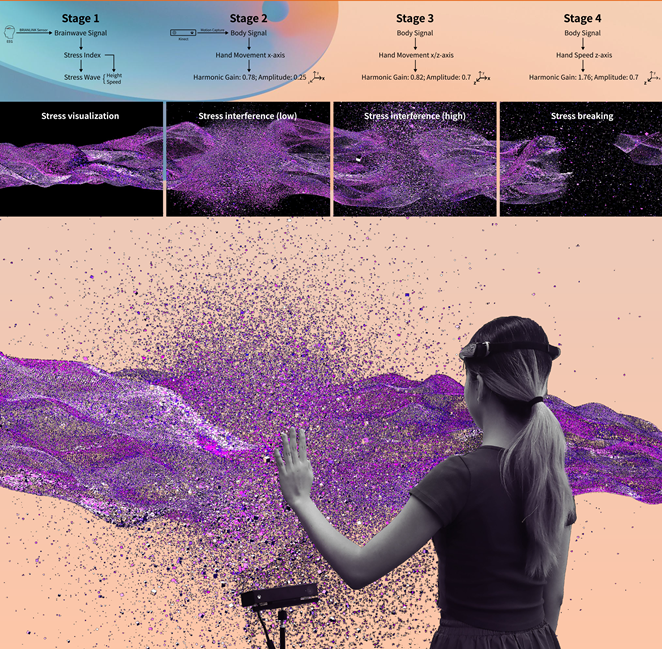
Grounded in psychological capital (PsyCap) and self-efficacy, this interactive experience uses biodata sensing and processing and motion capture. EEG visualizes stress levels in real time, while subsequent interaction triggers participants' responses to their stress.
This interactive experience builds upon the concept of psychological capital (PsyCap) and self-efficacy. By utilizing bio-data detection and processing, together with a motion capture system, stress levels are visualized in real-time through EEG, while a following interaction process can trigger individuals' responses to it.
Digital Corpse Donator: A Caring Digital Burial Process
Authors:
Fangze Qiu
University of Arts London
Yue Li
Supervisor, Xi’an Jiaotong-Liverpool University
Description:
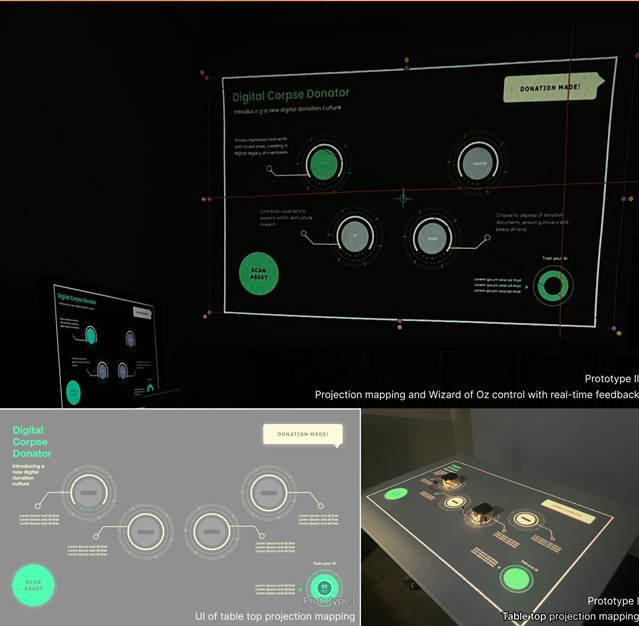
Developed with AXA Health in the UK, Digital Corpse Donator promotes data donation and better posthumous digital management. It encourages selective preservation and responsible disposal of data, questions corporate control of digital assets, and raises awareness of digital inheritance.
Digital Corpse Donator concept, in collaboration with AXA Health UK, promotes data donation to optimize after-death digital management. This initiative encourages selective data preservation and responsible disposal, fostering awareness of handling digital legacies while questioning corporate control over our digital assets.
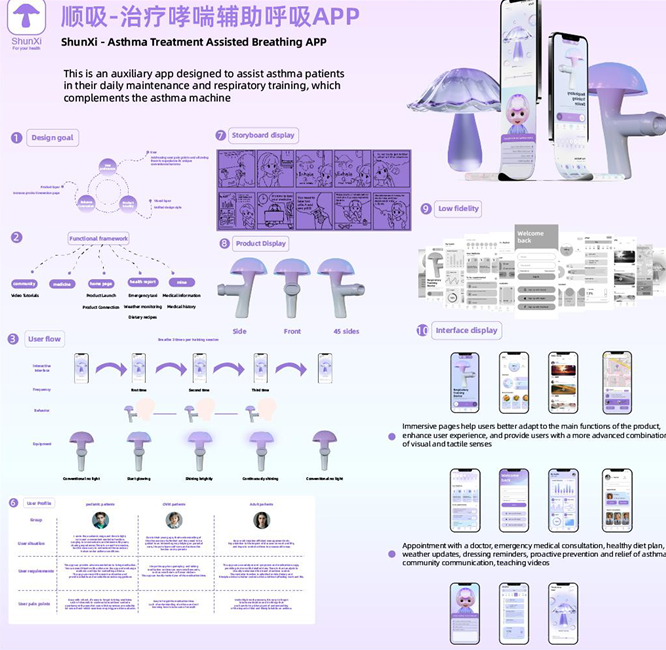
ShunXi: Asthma Treatment Assisted Breathing APP
Authors:
Weiyi Zhao
Zeqian Jiao
Wuhan Textile University
Qi Chen
Supervisor, Wuhan Textile University
Description:
A wearable device combining sound recognition, machine learning, and multisensory feedback to transform traditional behavior through technology.
A wearable device based on sound recognition, machine learning, and multi-sensory feedback, aimed at transforming traditional behaviors through technology.
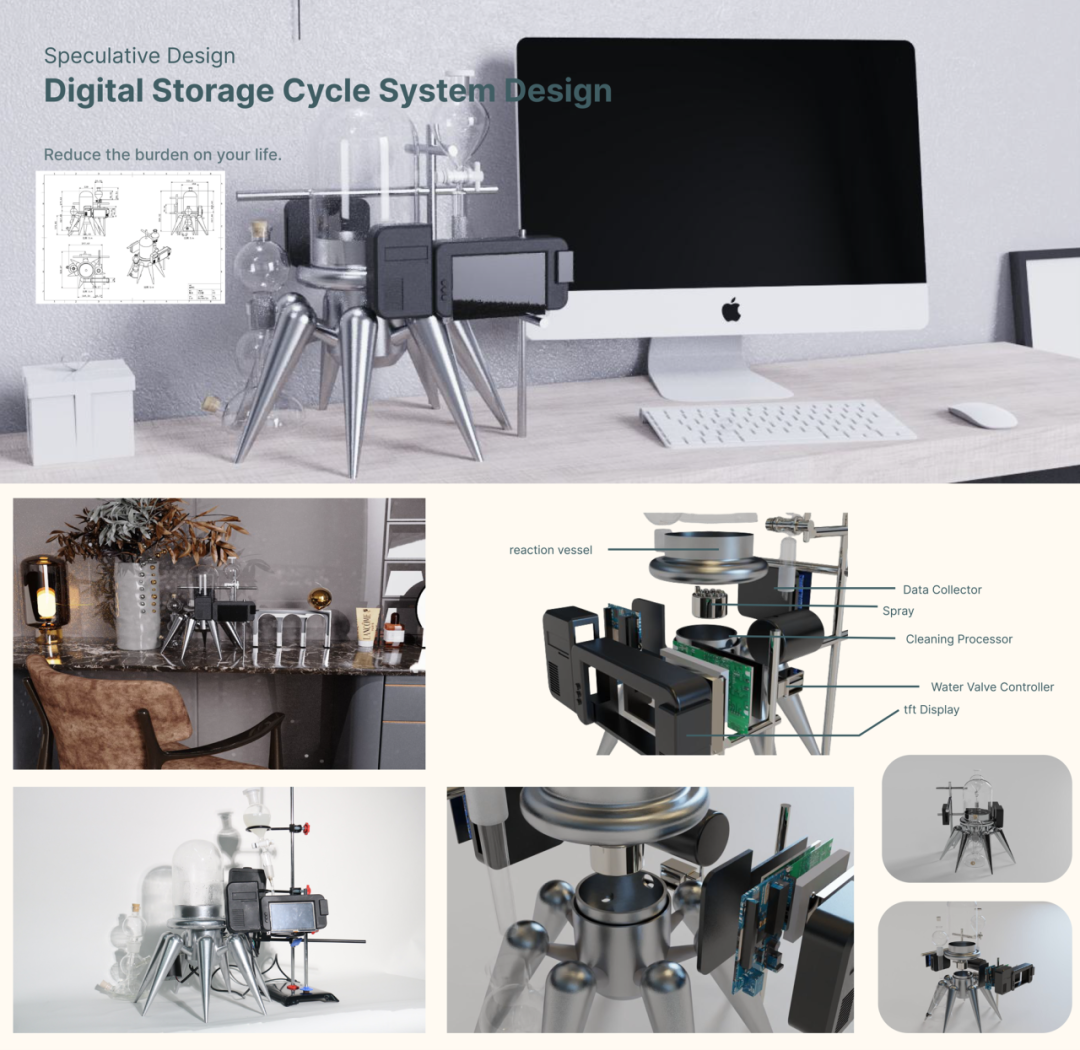
Digital Storage Cycle System Design
Authors:
Shuwei Huang
City University of Macau
Description:
An assistive application supporting daily asthma care and breathing exercises, complementing an asthma handbook.
This is an auxiliary app designed to assist asthma patients in their daily maintenance and respiratory training, which complements the asthma machine.
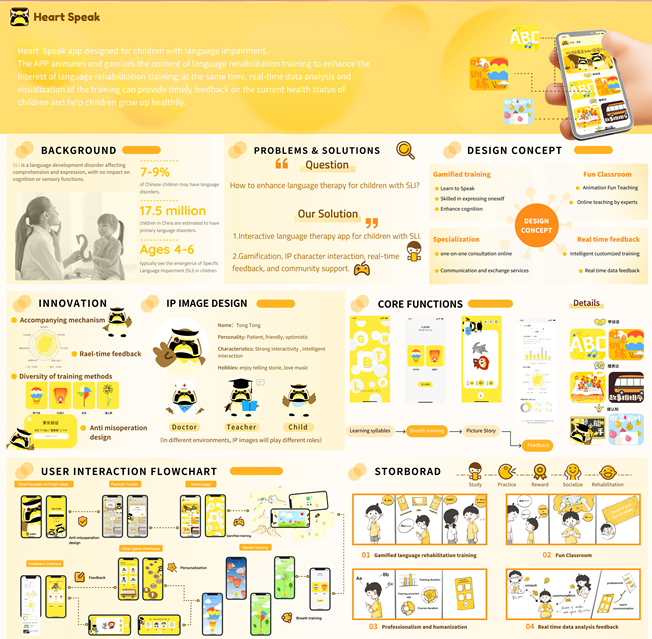
Heart Speak
Authors:
Xinyu Liu
Fanxia Kong
Yanyan Huang
Jiamei Liu
Zhuoyan Jiang
Wuhan Textile University
Qi Chen
Ju Xiong
Supervisor, Wuhan Textile University
Description:
A speech rehabilitation training application designed for children with language impairments.
A language rehabilitation training app designed for children facing language barriers.
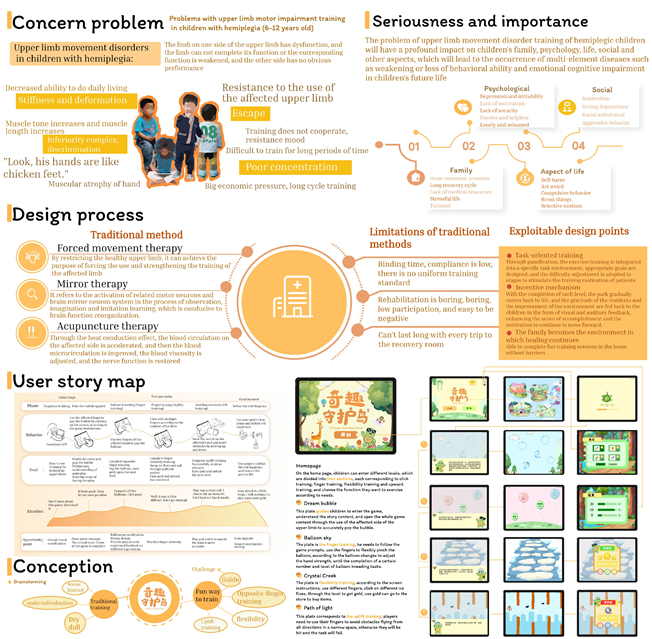
"Strange Guardian Island": a serious game design for upper limb movement disorders in children with hemiplegia
Authors:
Yameng Li
Pan Chen
Wuhan Textile University
Qi Chen
Supervisor, Wuhan Textile University
Description:
Strange Guardian Island combines rehabilitation exercises for children with hemiplegia with a fantasy adventure. Filled with courage and hope, it makes rehabilitation engaging and challenging rather than monotonous, supporting meaningful progress toward recovery.
"Strange Guardian Island" is a rehabilitation game designed for children with hemiplegia, cleverly combining rehabilitation training with fantasy adventure. It is an adventure of courage and hope that makes the healing process not boring, but full of fun and challenge. A solid step toward recovery.
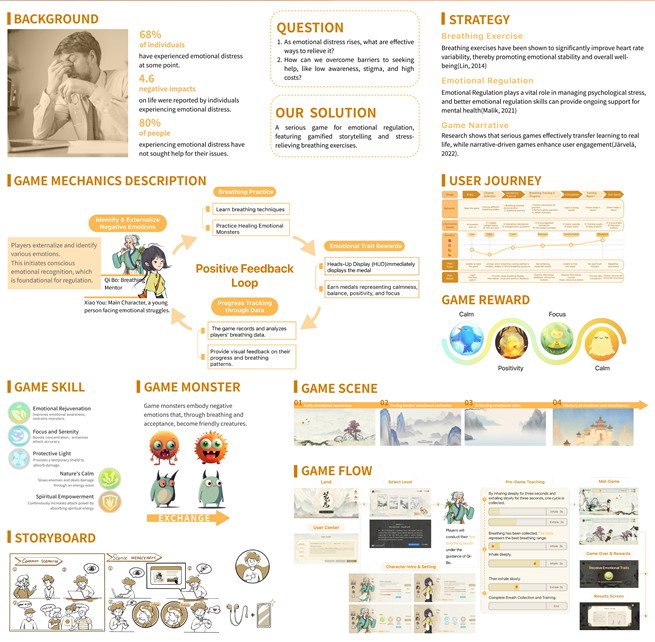
Breathe Harmony - A Chinese-style serious game that uses breathing to regulate negative emotions.
Authors:
Lingyan Wang
Wuhan Textile University
Yijun Lin
Shanghai University
Xingteng Xu
Zhuoyan Jiang
Wuhan Textile University
Qi Chen
Qiwei Xiong
Supervisor, Wuhan Textile University
Description:
Breathe Harmony is a serious game that improves young people's emotional regulation through structured breathing exercises. Immersive storytelling and visually engaging alternative-world design encourage guided breathing for stress relief and self-regulation.
Breathe Harmony is a serious game designed to improve emotional regulation in young people through structured breathing exercises. By integrating an immersive narrative and visually engaging alternate-world design, the game encourages players to participate in guided breathing for stress relief and self-regulation.
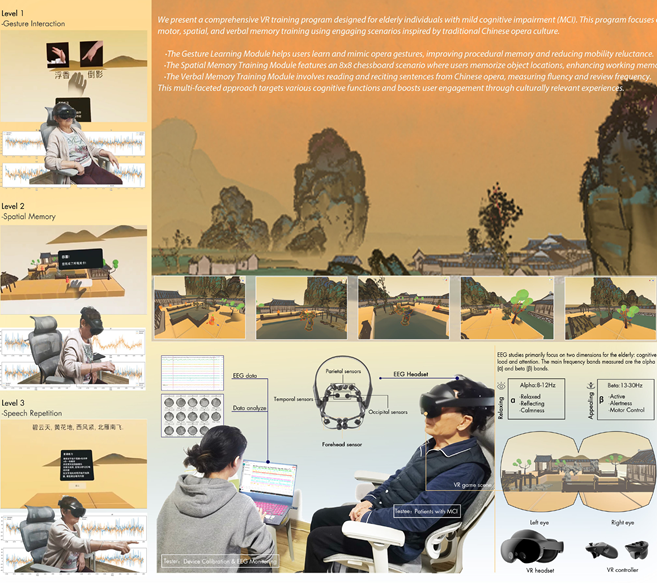
The Memory Garden: A VR Opera Culture Memory Training Experience for Elders with Cognitive Impairments
Authors:
Zeyi Sun
Tsinghua University
Xiaopan Hu
Xinyan Gao
Shenshen Lei
Layla
Ziyu Han
Supervisor, CMU Human-Computer Interaction Institute
Description:
Our VR training program for older adults with mild cognitive impairment (MCI) combines motor, spatial, and verbal memory exercises in immersive Chinese opera settings. Strengthening procedural, working, and verbal memory, it offers a culturally rich approach that increases engagement while balancing cognitive load and advancing VR-based cognitive rehabilitation.
Our VR training program for elderly individuals with mild cognitive impairment (MCI) integrates motor, spatial, and verbal memory training in immersive Chinese opera scenarios. By enhancing procedural, working, and verbal memory, it offers a culturally enriched approach that boosts engagement and balances cognitive load, advancing VR training in cognitive rehabilitation.
Blurring Boundaries
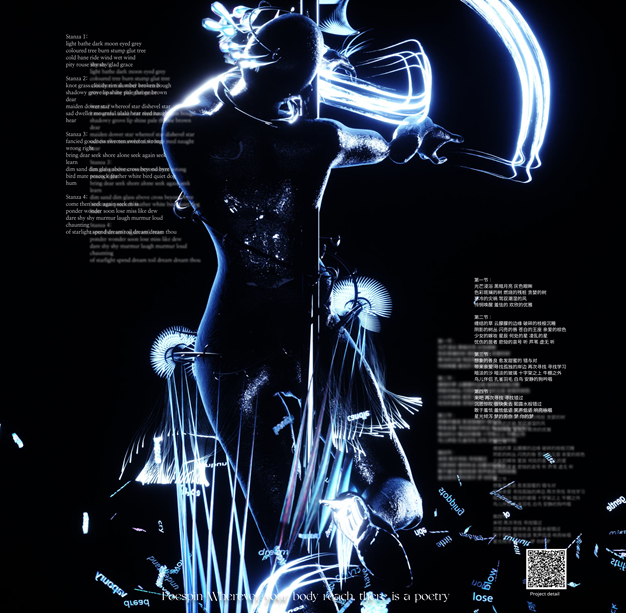
Poespin - Wherever your body reaches, there is the poetry
Authors:
Yihua Li
Yiqing Li
Jiayi Li
Armon Naeini
New York University
Hongyue Cheng
Universitat Freiburg
Yetong Xin
Harvard University
Yuqian Sun
Royal College of the Arts
Allison Parrish
Marcel Oliver-Rose Truxillo
Supervisor, New York University
Description:
PoeSpin is a human–AI co-creative writing system that transforms pole dancing into poetry, bridging movement and poetic expression. By capturing dancers' movements and translating them into poetry through AI, it responds algorithmically to Yeats's famous question: 'How can we know the dancer from the dance?'
PoeSpin is the human-AI cocreating writing system that transforms pole dance into poetry, creating a bridge between dance movement and verse. By capturing dancers' motions and translating them into poetic expressions through AI, this project answers Yeats's famous question - "How can we know the dancer from the dance?" - through algorithmic poetry.
Death of Moth: Exploring the Relationship Between Technology and Nature Through Immersive Spatial Exhibitions
Authors:
Jingjing Zhang
Xiaoxiao Wang
Rui Liu, Huize Wan
Lanyan Wei
Beijing Jiaotong University
Jingya Li
Yang Jiang
Yuxiao Yi
Supervisor, Beijing Jiaotong University
Description:
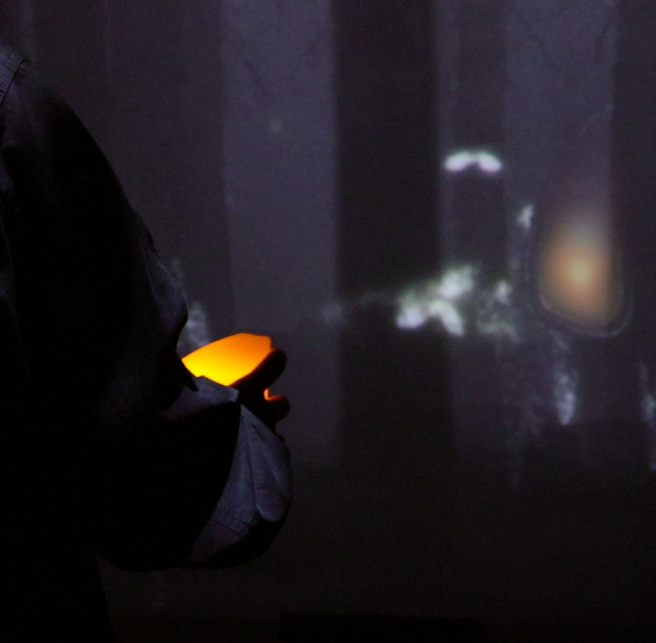
Death of Moth is an immersive exhibition in which participants interact while holding candles. Within this poetic space, they reflect on the delicate balance between humans and nature and the quiet distance created by technology.
"Death of the Moth" is an immersive exhibition where participants interact by holding a candle. As the flame nears, the moths ignite and fall softly as ash, veiling the moon's gentle light. This poetic space beckons reflection on humanity's delicate balance with nature and the quiet distances technology creates.
The Symphony
Authors:
Limeng Wang
Yian Wang
Qu Fu
Can Feng
Beijing Jiaotong University
Jingya Li
Yuan Yao
Supervisor, Beijing Jiaotong University
Description:
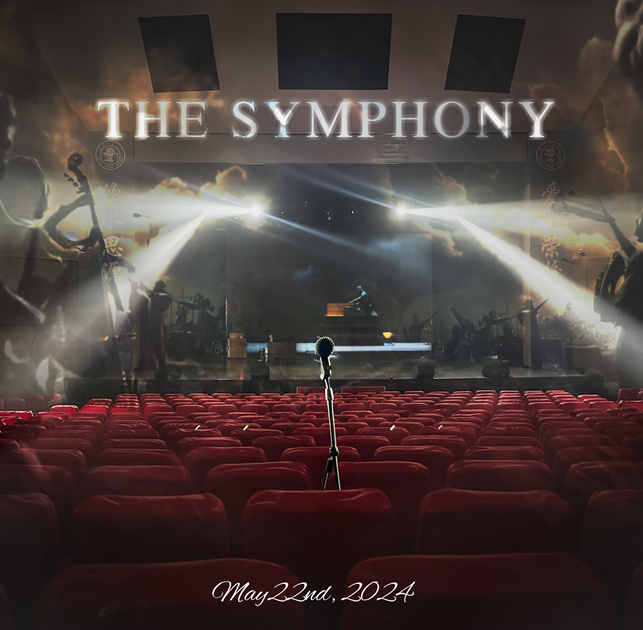
The Symphony is a four-minute interactive performance inspired by Mahler's First Symphony. Combining traditional symphonic elements and modern technology, it lets participants shape the experience through vocalization and AI interaction, exploring artistic expression and democratized creation in the digital age.
"The Symphony" is a 4-minute interactive performance inspired by Mahler's Symphony No. 1. It blends traditional symphonic elements with modern technology, allowing participants to shape the experience through vocalizations and AI interaction. The piece explores the future of artistic expression and democratized creation in the digital age.
The Unknown City
Authors:
Yu Chen
Tsinghua University
Yufan Xie
University of Southern California
Yan Wu
Supervisor, Southern University of Science and Technology
Description:
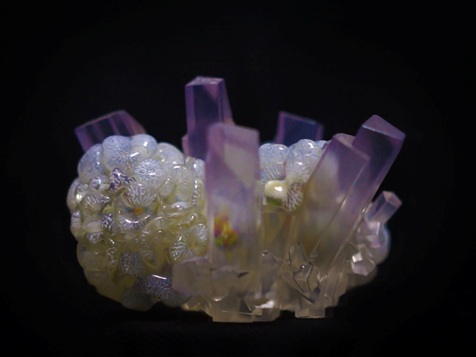
The Unknown City is an art series inspired by the science fiction story Nine Cities, Myriad Futures, imagining humans returning urban space to Earth and transforming it into a natural celestial body. The story compiles relationships between humanity, architecture, and cities, filled with unimaginable urban forms and unknown creatures. The series presents four extraordinary future cities that defy physics, burrowing underground, soaring through the sky, or attaching to other organisms. The Crystal Season marks Earth's final phase before eternity: human-built structures shrink, fade, and become transparent. Our generation disappears with them—not through death, but rebirth. New human–nature and city–architecture relationships will emerge elsewhere in the universe.
"The Unknown City" is an art series inspired by the sci-fi short story "Nine Cities and Ten Thousand Futures," which envisions humanity returning urban spaces to Earth, transforming Earth into a natural celestial body. The story is a compendium of human architecture and city relationships, with countless unimaginable urban forms and unknown creatures. The art series showcases four futuristic city super-forms that defy the laws of physics, capable of submerging into the ground, soaring into the sky, or even attaching to other organisms. As the "Crystal Season" arrives, marking Earth's final phase before eternity, all man-made structures begin to contract, fade, and become transparent. Humanity, our generation, will also pass away with this process, but not in death; it's a rebirth. New nature - human and city - the relationship with architecture will be naturally created elsewhere in the universe.
The Wall
Authors:
Zixuan Zhou
Beijing University of Financial Technology
Description:
The film combines bodily experiences of traditional earthen houses and contemporary living spaces, exploring cycles between imagined, real, and remembered spaces and the illusions produced by networked information, mobile screens, and virtual reality.
The film attempts to merge different bodily experiences from traditional earthen houses of the past and contemporary everyday spaces, exploring the cyclical relationship between sensory dimensions of "imaginative space, real space, and memory space," and the illusion created by "network information space, mobile screen space, and virtual reality space."
EMBERS - Improve survival chances beyond critical 72-hour period for those trapped in rubble from conflicts and disasters by maintaining a positive mental attitude through RF communication and HCI method
Authors:
Mengze Zou
Imperial College London & Royal College of Art
Zhejun Zhang
China Academy of Art
Xinhang Guo
The University of Manchester
Gareth Loudon
Supervisor, Royal College of Art
Stephen Green
Supervisor, Imperial College London
Description:
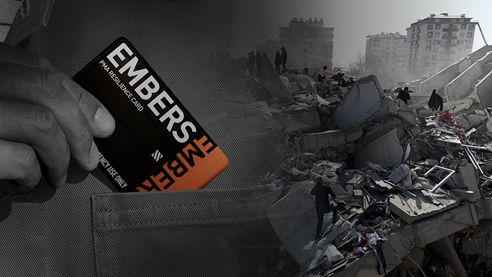
EMBERS establishes two-way communication to sustain the will to survive among people trapped in rubble until rescuers arrive. It also lets rescue teams locate them using inexpensive equipment, particularly important where ground-penetrating radar is unavailable. Compact hardware comprises a microcontroller, low-power RF transceiver, vibration motor, piezoelectric ceramic, and battery, activated manually or through external pressure. Research suggests vibrations mimicking deep breathing can unconsciously encourage slower breathing, reducing anxiety and panic. Activation triggers vibration and a signal that remotely activates nearby EMBERS devices. Their continuing vibrations reassure trapped people that they are not alone. Remote activation keeps devices useful when users cannot move their hands. Rescuers can also activate them on the same frequency; preset messages switch to rapid vibrations to signal that help is nearby and sustain hope.
EMBERS helps those trapped under rubble maintain their will to survive by establishing two-way communication until rescue arrives. It also enables rescue teams to locate them using low-cost devices, crucial in less developed areas lacking penetrating radar. The EMBERS hardware consists of a microcontroller, low-power RF transceiver, vibration motor, piezoelectric ceramic, and battery, integrated into a compact size. The device can be activated by manual or external presses. Research shows that vibrations mimicking deep breathing rates can subconsciously induce deep breathing, helping the trapped individuals reduce anxiety and panic. When they activate their device, it vibrates and sends a signal to remotely activate other nearby EMBERS devices. Continuous vibrations from each other's devices reduce loneliness by making trapped individuals aware they are not alone. If a person's hands are restricted, remote activation ensures the device still works. Rescue personnel can also remotely activate devices on the same radio frequency. Different preset information allows the device to switch to a rapid vibration mode, signalling the trapped person that the rescue team is nearby, helping maintain their will to survive.
Dialogue of Self-Relationships
Authors:
Kaiqing Huang
Qiao Xiao
Xiaoqin Zhou
Duoduo Liang
China Academy of Art
Tongzhou Yu
Yongru Lu
Jiaming Wang
Supervisor, China Academy of Art
Description:
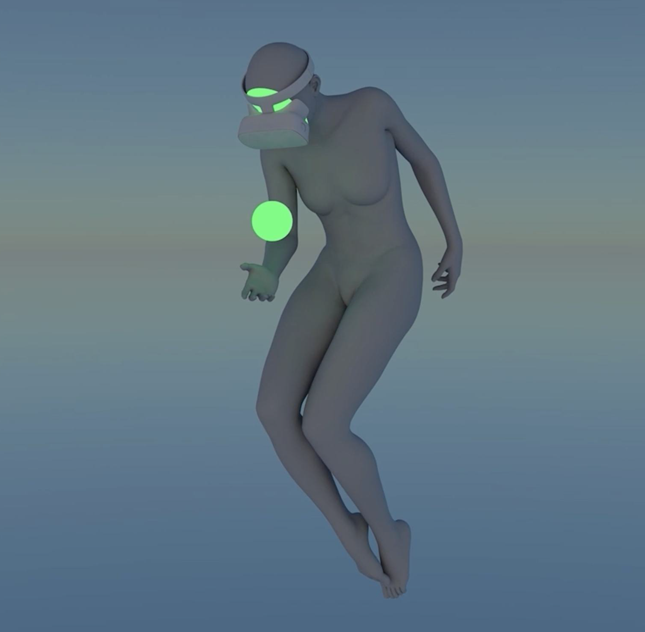
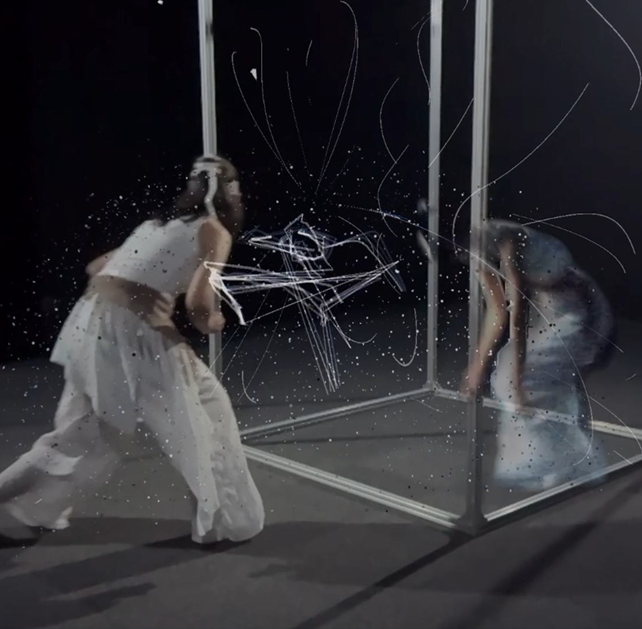
Self-Relationship Dialogue is a live performance combining augmented reality, dance, and human–computer interaction. It explores relationships among real dancers, virtual dancers, and audiences, considering possibilities for their identities and perceptions.
"Dialogue of Self-Relationships" is a real-time performance combining Augmented Reality, dance, and human-computer interaction. We explore the relationships between real dancers, virtual dancers, and the audience. In this context, we investigate the possibilities of identity and perception among them.
NA-Masses
Authors:
Yuting Xue
City University of Hong Kong
Elke Reinhuber
Supervisor, City University of Hong Kong
Description:
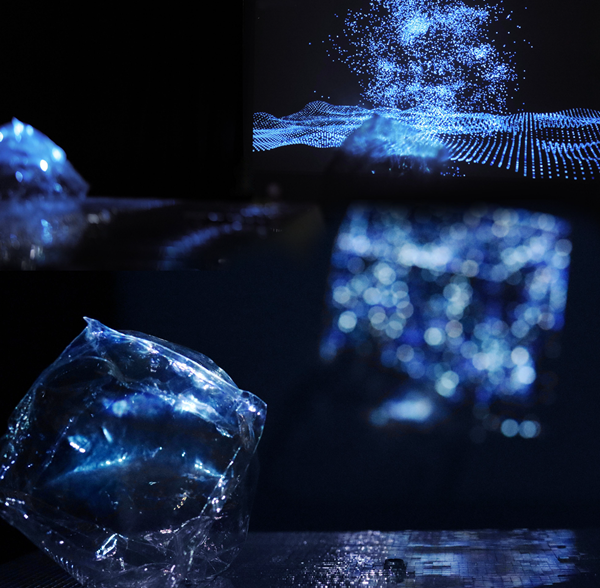
NA-Masses is a multisensory installation speculating on future geoengineering in which natural aerosols are emitted through human embodiment. Drawing on current science and speculative design, it encourages reflection on sustainability and examines embodied interaction's role in creating dialogue between humans and the posthuman.
NA-Masses is a multi-sensory installation that speculates a geoengineering future of launching natural aerosols through the embodiment. Based on current science and speculative design, it aims to encourage public reflection regarding sustainable development and explore the role of embodied interactions in creating dialogues between humans and post-humans.
Temporal Drift
Authors:
Xuezhu Wang
Yao Lu
Xiwen Yao
Zhihao Yao
Tsinghua University
Haipeng Mi
Supervisor, Tsinghua University
Description:
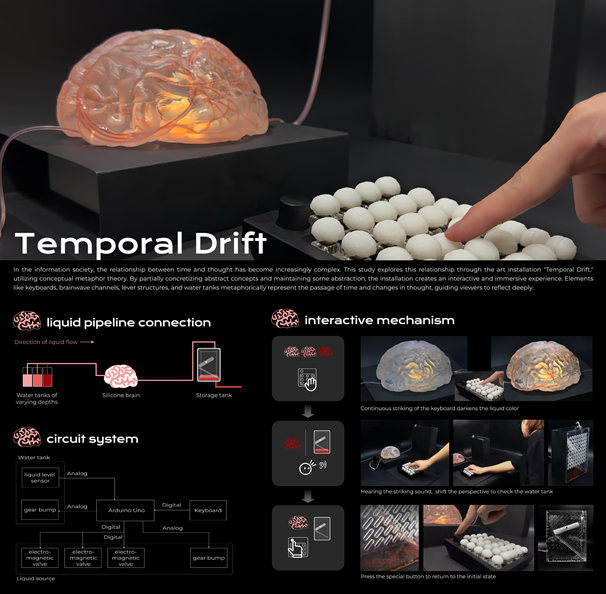
Time and thought are increasingly intertwined in the information society. Using conceptual metaphor theory, Temporal Drift explores this relationship through an art installation. By partially materializing abstract concepts while preserving some abstraction, it creates an interactive, immersive experience.
In the information society, the relationship between time and thought has become increasingly complex. This study explores this relationship through the art installation "Temporal Drift," utilizing conceptual metaphor theory. By partially concretizing abstract concepts and maintaining some abstraction, the installation creates an interactive and immersive experience.
Eyes in the Sky
Authors:
Xueqi Wang
Xi’an Jiaotong-Liverpool University
Yue Li
Supervisor, Xi’an Jiaotong-Liverpool University
Description:
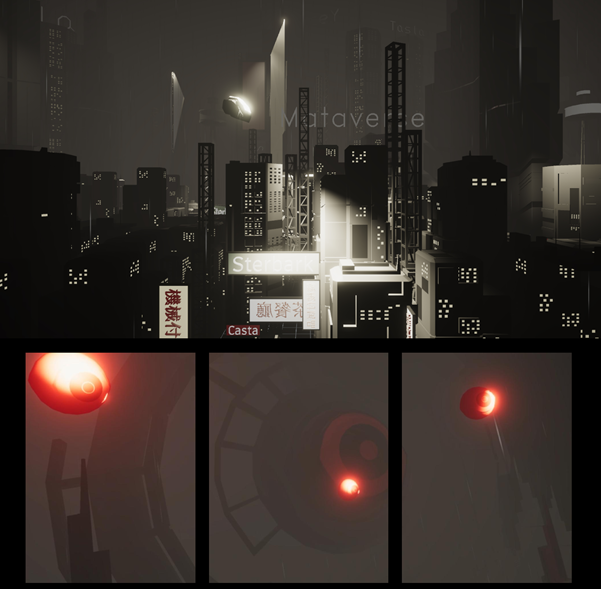
Eyes in the Sky is a VR experience combining art, science, and humanity, inspired by Brave New World and cyberpunk classics. In a mechanized world pursuing social stability, untamed humans are hunted by Eyes in the Sky robots, questioning technological control and the price of stability.
"Eyes in the Sky" is a VR experience blending art, science, and humanity, inspired by "Brave New World" and cyberpunk classics. lt explores a mechanized world for social stability, where undomesticated humans are hunted by sky-eye robots, questioning technology's control and the cost of societal stability.
Blind Release - The Truth about Gossip Roulette
Authors:
Ge Gao
Beijing Jiaotong University
Yipeng Wang
Supervisor, Royal College of Art
Yuan Yao
Supervisor, Beijing Jiaotong University
Description:
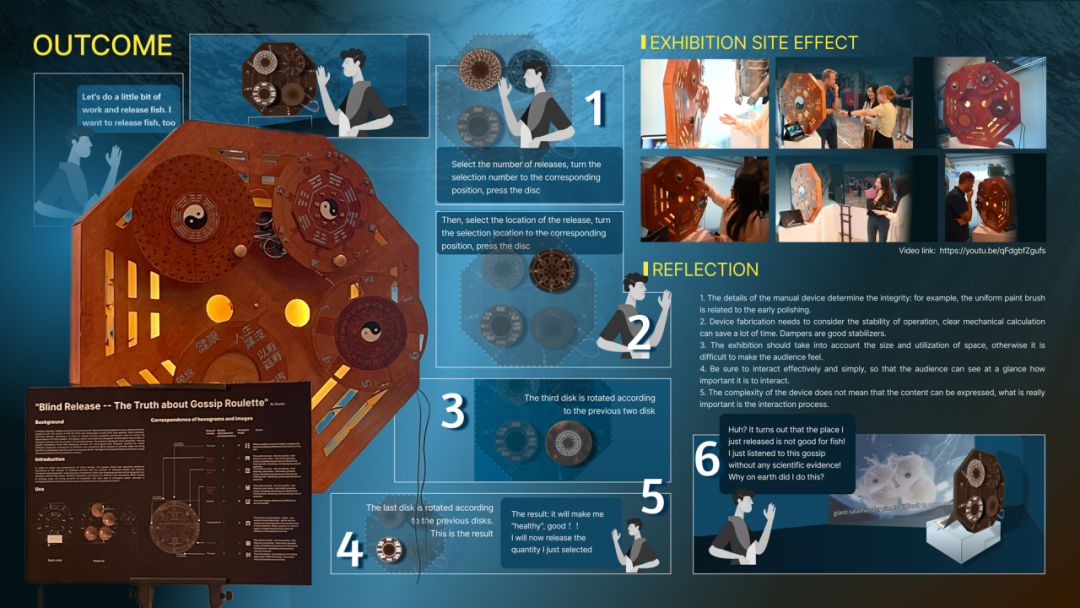
Animal release is common today but often indiscriminate. People release animals at rivers and parks for personal blessings, desire, or conformity, ignoring science and causing unplanned releases to proliferate. An eight-trigram wheel exposes this practice. Based on the numbers of animals and release sites, its attractive front suggests good fortune, while images on the reverse reveal different realities. Indiscriminate release may instead kill organisms, disrupt ecological balance, and introduce invasive species.
In today's society, release is common but more blind. News Common people in rivers, parks and other places at will, the reason is that for their own blessings to meet their own desires, herd mentality, ignoring science, resulting in a flood of release without scientific planning. In order to reveal the phenomenon of blind release, the gossip wheel was specially designed. According to the number of released animals and the number of released places, the positive hexagram looks beautiful, making people mistakenly think that releasing animals will bring good luck. However, behind the wheel, different diagrams correspond to different real situations. Blind release of animals does not bring benefits as expected, but may lead to biological death, damage to ecological balance and even cause serious problems such as species invasion.
Symbiosis and Fracture
Authors:
Xuesong Wang
Central Academy of Fine Arts
Tong Lin
Supervisor, Central Academy of Fine Art
Description:
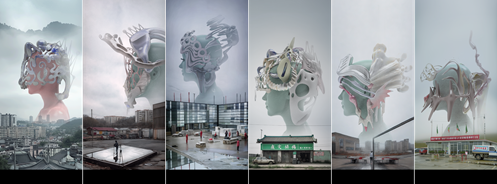
This work portrays a future city in which human–machine relationships are recreated. Surreal mechanisms merge mechanical virtual imagery with the real city, representing technology's pervasive power and our gradual loss of identity within it. In this changing environment, human identity shifts toward mechanization and virtualization. The work asks whether genuine technological symbiosis is possible, or whether connections between people and their environment have already been irreversibly severed.
This work presents a portrait of a future city, in which the relationship between human beings and machines is recreated and reconstructed. By integrating the virtual image of machinery with the real city, these surreal mechanical devices not only symbolize the pervasiveness of technical power, but also reflect the essence that we are gradually lost in this power. In the ever-changing environment, human identity has begun to transition to mechanization and virtualization. Through art, I want to arouse the audience to think: Can we form a real symbiotic relationship with technology? Or has the connection between man and the environment been irreversibly broken in this process?
Vir Us
Authors:
Junyan Du
Tsinghua University
Qianqian Zhang
University of the Arts London
Description:
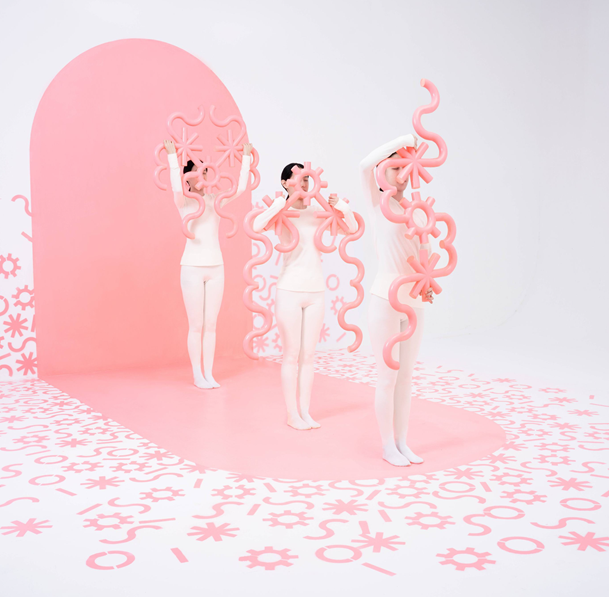
Research identifies endogenous retroviruses as essential to placental development, suggesting they helped shape human life. Vir Us is a conceptual armor design linking viruses, the sun, and the umbilical cord, exploring symbolic expressions of viruses' protective and life-giving roles.
Research shows that endogenous retroviruses are key to placental development, suggesting they may have shaped human life. Vir Us is a conceptual design linking elements like viruses, the sun, and the umbilical cord in an armor-like style, exploring new symbolic expressions to highlight the protective and life-giving roles of viruses.
Whisper
Authors:
Hanxuan Li
Tsinghua University
Enqi Huang
Central Academy of Fine Arts
Xiaowen Chen
Supervisor, Alfred University
and Central Academy of Fine Arts
Description:
We collected hundreds of original works on My Dream from primary school children across China. Just as genes store biological traits, these distilled expressions metaphorically encode society's future environment.
We have collected hundreds of original compositions from elementary school students across the country with the theme "My Ideal." Genes store the trait information of organisms, and these essences serve as the "Genes" metaphorizing future social culture. heartwork Whisper establishes a connection between the two.
Blood, Clan, Artificial Intelligence
Authors:
Yuxiang Ji
Waseda University
Silong Zhao
University College London
Min Fan
Wenjuan Chen
Supervisor, Communication University of China
Description:
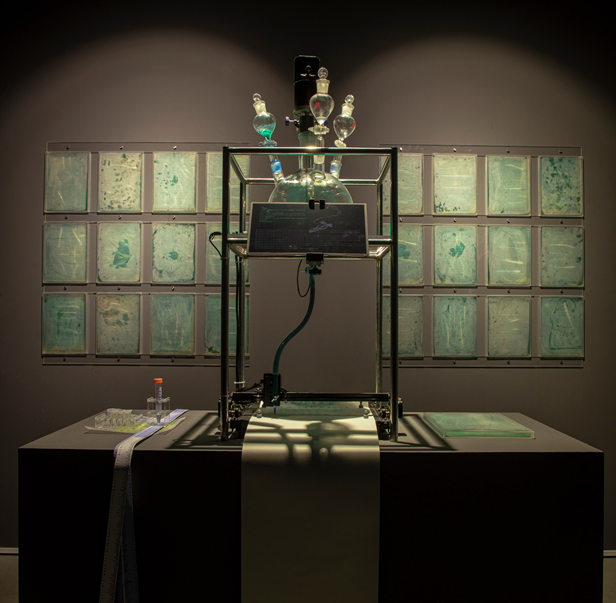
This work explores the history and current experience of migration in China. Connecting clan culture, war, urbanization, and wisdom, it reveals population change and collective memory and mobility's challenges for individuals and society.
This work explores the history and current situation of China's floating population, combining clan culture, war, urbanization and intelligence to present demographic change and collective memory, and to reveal the challenges that mobility poses to both individuals and society.
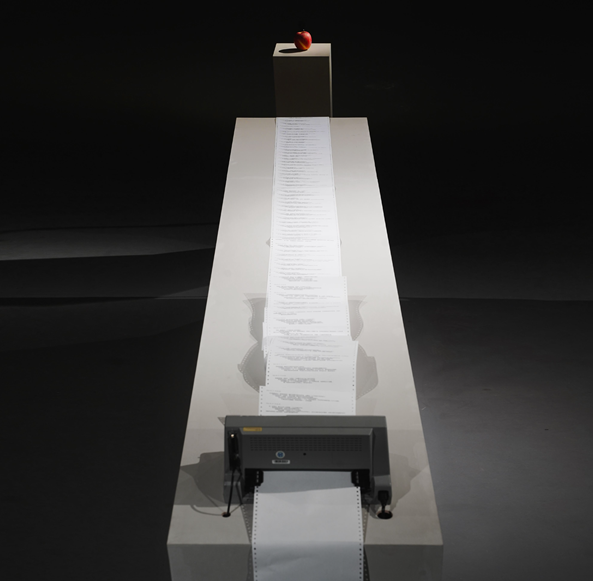
The Apple’s Decay
Authors:
Enqi Huang
Central Academy of Fine Arts
Xintong Wang
Central Academy of Fine Arts
Hanxuan Li
The Future Laboratory, Tsinghua University
Xiaowen Chen
Supervisor, Alfred University
and Central Academy of Fine Arts
Haipeng Mi
Supervisor, Tsinghua University
Description:
AI describes an apple and simulates its condition, but language lags behind reality, revealing decay and the disconnection among human cognition, machine cognition, and reality.
AI describes an apple, simulating its state, but language lags behind reality, revealing "decay" and the disconnect between human, machine cognition, and reality.
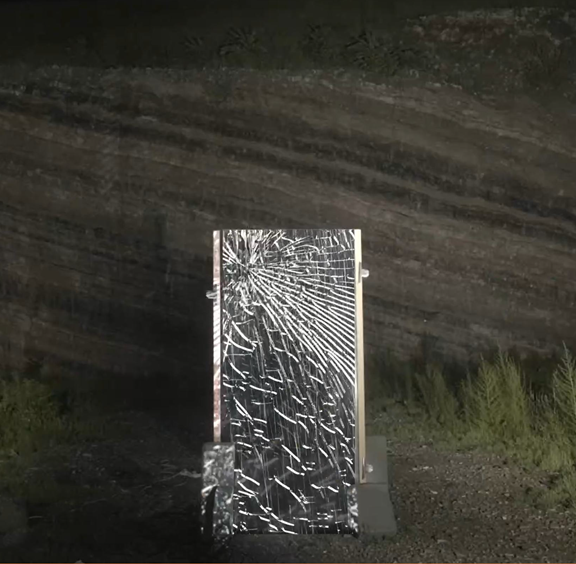
Black Clay Pot
Authors:
Enqi Huang
Central Academy of Fine Arts
Hanxuan Li
Tsinghua University
Xiaowen Chen
Supervisor, Alfred University
and Central Academy of Fine Arts
Description:
The work merges bodies and objects, blurring their boundaries into a system of irreversible growth, reaction, and entanglement that reflects social conflict.
The work merges body and object, blurring boundaries between them, creating a system that grows, responds, and entangles irreversibly, reflecting societal conflicts.
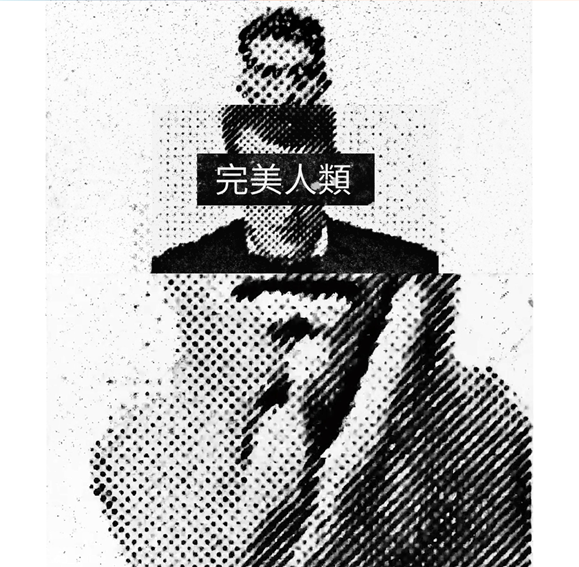
The Perfect Human
Authors:
Lilan Yang
Rhode Island School of Design
Description:
Using unsupervised machine learning and experimental filmmaking, analog film becomes digital video and then analog film again. Moving from a proxy for human memory to a machine-learning construct, the work reexamines AI's contested notion of perfection.
Digital remake of Jørgen Leth’s The Perfect Human reexamines and questions the contested notion of perfection in the eyes of artificial intelligence, through unsupervised machine learning and experimental filmmaking techniques, transforming analog film to digital video and back, from a proxy of human memories to the machine learning construct.
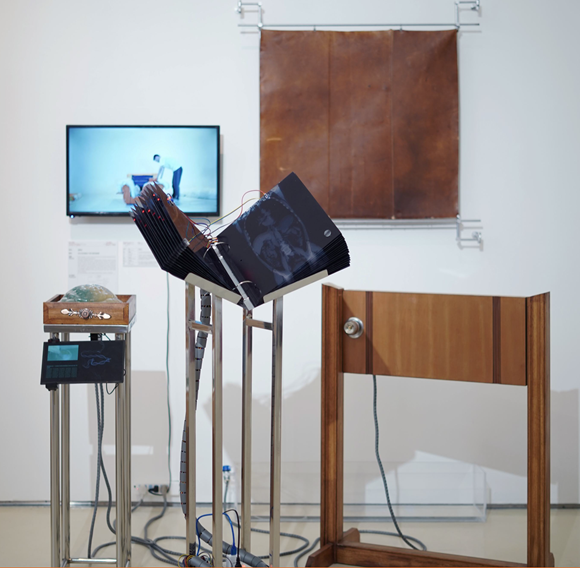
Echo-Space
Authors:
Changran Zhao
Communication University of China
Yuxiang Ji
Waseda University
Silong Zhao
University College London
Yukai Liu
Communication University of China
Min Fan
Ye Wang
Xinyi Zhang
Sibo Yang
Supervisor, Communication University of China
Description:
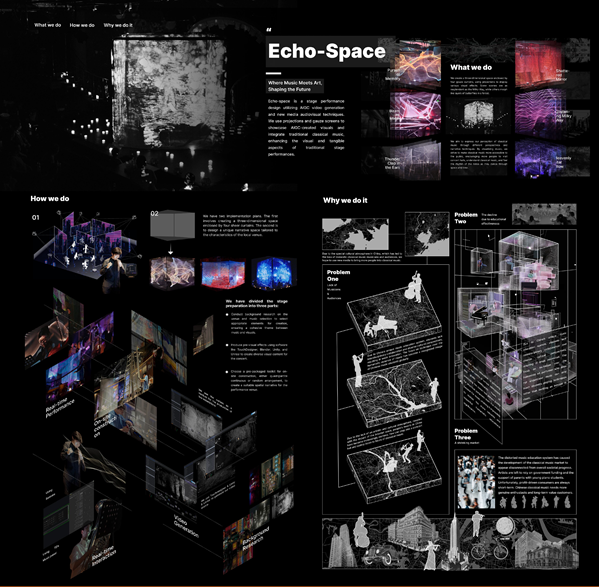
Echo-Space is a stage performance design using AIGC video and new-media audiovisual technology. Projection and scrims display AI-generated visuals alongside traditional classical music, enhancing the visual and tangible qualities of conventional performance.
Echo-space is a stage performance design utilizing AIGC video generation and new media audiovisual techniques. We use projections and gauze screens to showcase AIGC-created visuals and integrate traditional classical music, enhancing the visual and tangible aspects of traditional stage performances.
Shui's Odyssey
Authors:
Yanzhi Yang
Xiaolong Chen
Zhuoyue Song
Siyu Chen
Dingyin Shi
Yijia Fu
Lin Yin
Haoran Liu
Junyao Huang
Haoxuan Li
Binjing Zhang
Tsinghua University
Description:
A puzzle game combining words and images. Players use optical illusions to piece together the fragmented memories of a person with dementia, uncovering the story and revisiting three generations' lives.
This is a decryption game that combines text and images. Players use optical illusions to piece together the fragments of memory of Alzheimer's patients, so as to restore the truth of the story and relive the years of three generations.
Reflex Atrophy
Authors:
Shiyi Liu
Zixi Yang
University of Hertfordshire
Yingfei Xiong
Supervisor, Central Academy of Fine Arts
Description:
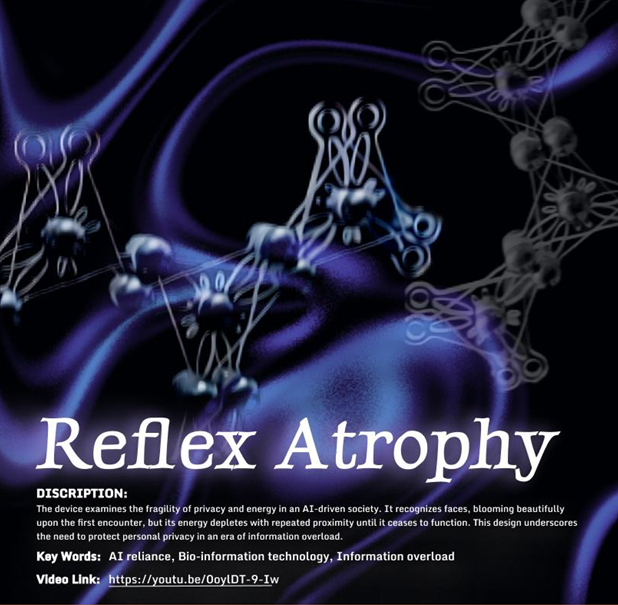
This installation examines the fragility of privacy and energy in an AI-driven society. It recognizes faces and glows beautifully at the first encounter, but repeated approaches drain its energy until it stops. The design highlights the need to protect personal privacy amid information overload.
The device examines the fragility of privacy and energy in an AI-driven society. It recognizes faces, blooming beautifully upon the first encounter, but its energy depletes with repeated proximity until it ceases to function. This design underscores the need to protect personal privacy in an era of information overload.
The Water Veins of Xicheng - An Interactive Website Design Based on Wuxi's Water Culture
Authors:
Xinjun Gong
Tsinghua University
Jie Zhang
Supervisor, Jiangnan University
Description:
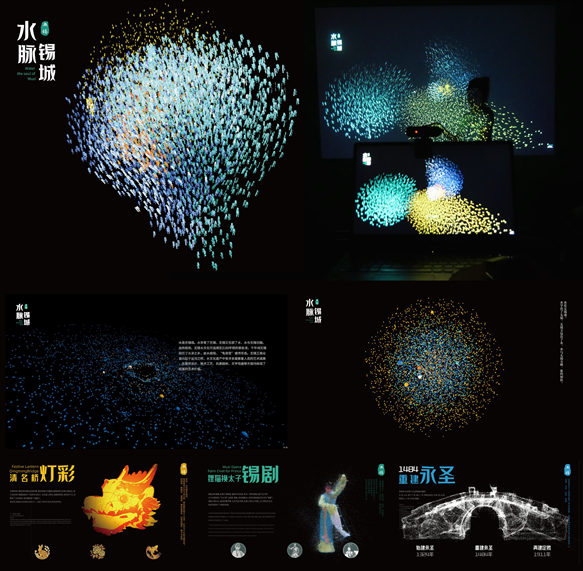
An interactive website about Wuxi's water culture uses dynamic charts to visualize cultural symbols, heritage, and urban narratives, highlighting the spirit, forms, and appeal of the city's water culture.
This project is an interactive website design showcasing Wuxi's water culture, visualizing cultural symbols through dynamic graphs to present cultural heritage and city narratives, highlighting the spirit, form, and charm of Wuxi's water culture.
SentAIment
Authors:
Qingran Zhang
Hong Kong Polytechnic University
Yun Hong
Supervisor, Tsinghua University
Description:
SentAIment combines AI and human emotion to pioneer empathetic technologies. It examines effective AI use, natural-language programming, and AI's understanding of emotion and cognition, while exploring the evolving role of prompts in future language-model-based human–AI interaction.
"SentAIment" merges AI with human emotions to pioneer empathetic technology. It examines effective AI use, focusing on natural language programming and AI's understanding of emotions and cognition, while exploring the evolving role of prompts in language models for future human-AI interactions.
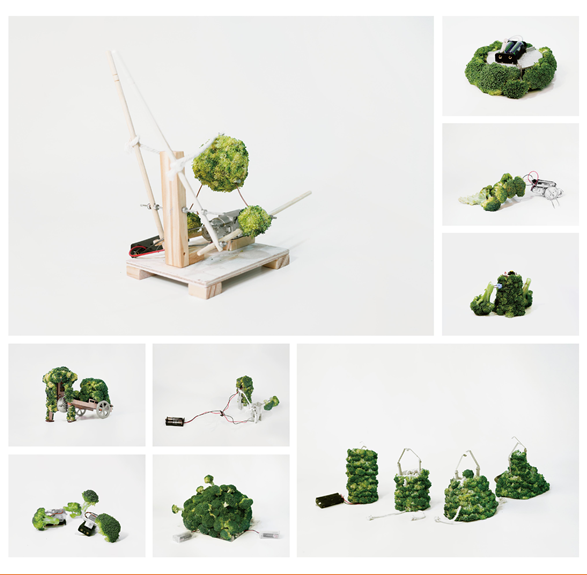
Cybroc
Authors:
Ke Huang
Yue Zhou
Xi He
Li Zhang
China Academy of Art
Botao Amber Hu
Supervisor,Reality Design Lab
Weibo Chen
Supervisor, China Academy of Art
Description:
Cybroc is a kinetic art series exploring longevity activism through satirical prosthetics for broccoli. Fitted with prosthetic limbs for longevity-enhancing workouts, broccoli prompts reflection on biological enhancement's limits and ethics. Juxtaposing a healthy vegetable with human enhancement, it challenges audiences to consider nature, technology, and posthuman aspirations for longer life.
"Cybroc" is a kinetic art series exploring longevity activism through the satirical cyborgization of broccoli. The artwork augments broccoli with prosthetic limbs to perform longevity-enhancing exercises, prompting reflection on the limits and ethics of biological enhancement. By juxtaposing a healthy vegetable with human enhancement concepts, "Cybroc" challenges viewers to consider the intersection of nature, technology, and our posthuman quest for extended lifespan.
Shower-thoughts
Authors:
Alex BAI
City University of Hong Kong
Elke Reinhuber
RAY LC
Supervisor, City University of Hong Kong
Description:
VR animation visualizes the artist's wandering thoughts and visions in the shower.
VR animation sequences that visualize the artist’s various wanderings in the showers.

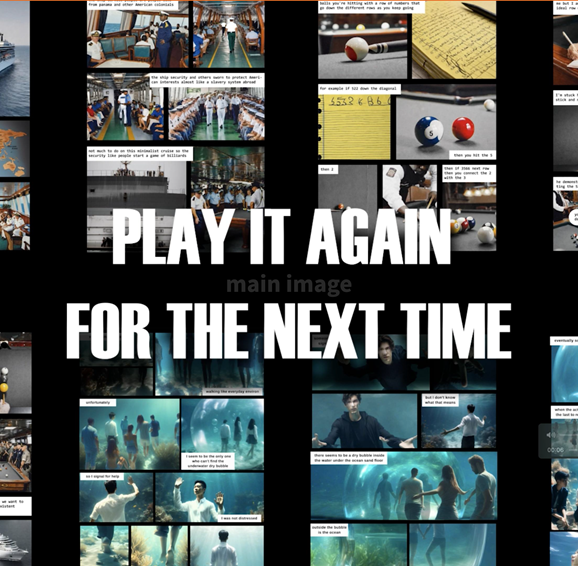
PLAY IT AGAIN, FOR THE NEXT TIME
Authors:
Yifan Zhao
Columbia University in the City of New York
Yuxuan Bai
City University of Hong Kong
Bowen Liu
Central Academy of Fine Arts
Zhipeng Jia
Shenyang Urban Construction University
Xiaoke Zeng
City University of Hong Kong
RAY LC
Supervisor, City University of Hong Kong
Description:
PLAY IT AGAIN, FOR THE NEXT TIME comprises visual dream narratives rendered through GenAI and VR. Capturing fleeting dream fragments and recreating unconscious hallucinations, it produces eight visually distinct narratives.
"PLAY IT AGAIN, FOR THE NEXT TIME" is a series of visual dream narratives interpreted through generative AI (GenAI) and Virtual Reality (VR). To capture the fleeting fragments of dreams and visually recreate these unconscious illusions, producing eight visually distinct narratives.
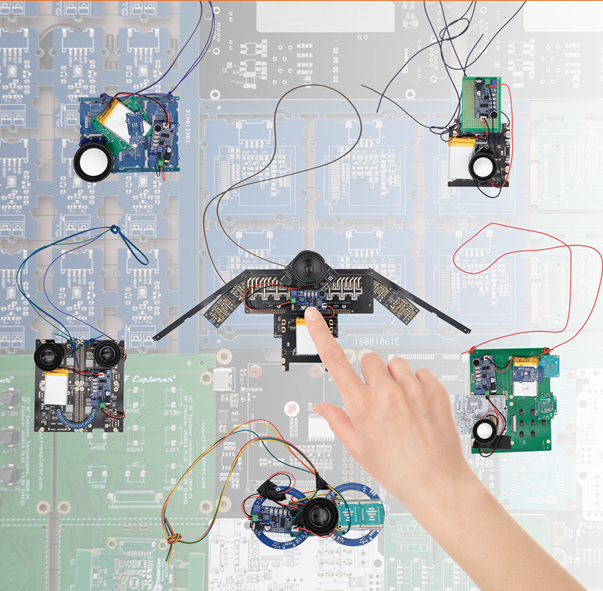
Low-Tech CitySound: An Art Installation Exploring Shenzhen’s Urban Soundscape Through Custom Electronics and Participatory Recordings
Authors:
Bo Dong
University College London
Zhaorui Liu
Southern University of Science and Technology
Marcel Zaes Sagesser
Supervisor, Southern University of Science and Technology
Description:
What if we listened to Shenzhen through custom, low-fidelity wearables? We built low-tech audio devices with eleven young people and recorded the city. Their chosen sounds produced curated, distorted urban images, exploring connections between electronic media and urban perception.
What if we listen to Shenzhen through custom-made, low-fi wearables? With eleven young adults, we built low-tech audio devices and recorded our city. They brought back sounds of their choosing, presenting us with a curated and distorted "image" of our city, investigating the connection between electronic media and urban perception.
The tears of the merfolk
Authors:
Yongyan Chen
Tianjin Academy of Fine Arts
Yingfei Xiong
Supervisor, Central Academy of Fine Arts
Description:
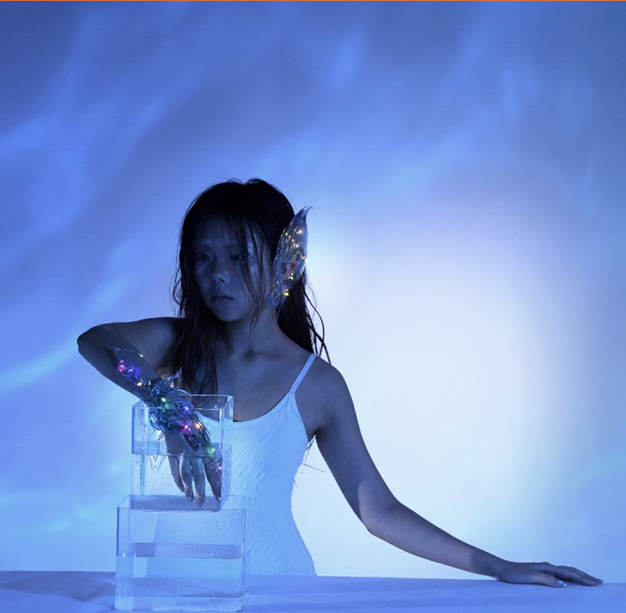
Inspired by pteropods and mollusks, this wearable monitors ocean pH and signals through flashing lights. It highlights marine ecosystems' vulnerability, critiques technology-driven alienation from nature, and promotes human–nature connection while addressing technological–ecological balance and environmental ethics.
A wearable device monitoring ocean pH, inspired by pteropods and mollusks. lt signals changes through flashing lights, highlighting marine ecosystem tragedy, critiquing tech-driven nature alienation, and promoting human-nature connection while addressing tech-ecology balance and environmental ethics.
Dreamscape moments
Authors:
Jinlin Miao
Yilei Wu
Yue Zhu
China Academy of Art
Tao Ran
Supervisor, China Academy of Art
Description:
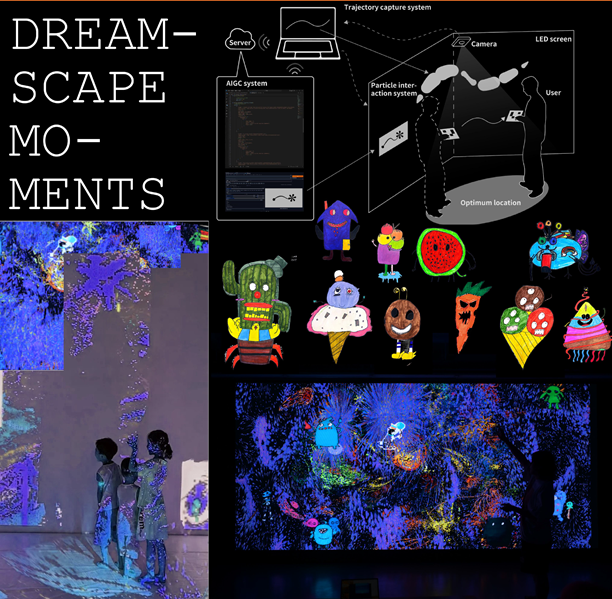
Dreamscape Moments collects children's dream-themed drawings to train an AI model generating childlike artwork, creating an interactive experience that combines visual art and immersive technologies.
"Dreamscape moments" collects children's drawings themed around dreams to train an AI model that generates artwork in a childlike style, aiming to create an interactive experience that blends visual art with immersive technology.
On the Street
Authors:
Nianhang Du
Hong Kong Baptist University
Linzhi Wang
Fashion Institute of Technology
Yiran Li
Carnegie Mellon University
RAY LC
Supervisor, City University of Hong Kong
Description:
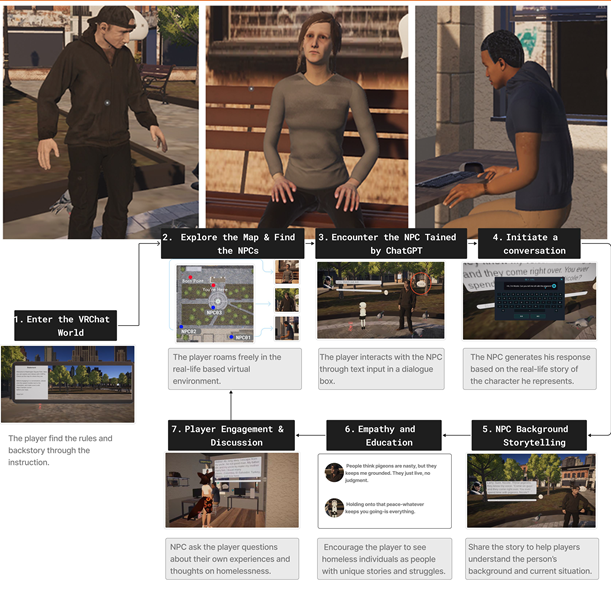
Our virtual experience uses LLM-driven NPCs modeled on interviews with unhoused people to challenge stereotypes and foster empathy. User tests showed players forming empathetic connections, often relating characters' stories to personal experiences, highlighting LLMs' potential to encourage compassion for marginalized communities.
Our virtual experience uses LLM-driven NPCs modelled from interviews with homeless individuals, aiming to challenge stereotypes and foster empathy. User testing showed players formed empathetic connections with these characters, often relating their stories to personal experiences. This highlights LLMs’ potential in promoting empathy for marginalized communities.
Affective Interfaces
Knock Knock
Authors:
Yunqing Zhao
Xin Xu
Kaige Guan
Siyuan Wang
Wuhan Textile University
Qi Chen
Lei Xiong
Ju Xiong
Runnan Li
Supervisor, Wuhan Textile University
Description:
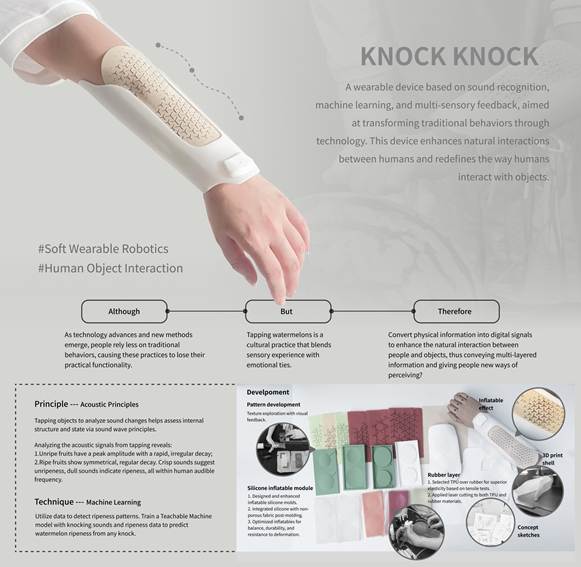
A wearable device combining sound recognition, machine learning, and multisensory feedback to transform traditional behavior through technology.
A wearable device based on sound recognition, machine learning, and multi-sensory feedback, aimed at transforming traditional behaviors through technology.
Lover's Eye: Design of Human-Computer Interactive Jewelry Based on Sleep Staging Algorithm Using Heart Rate Variability (HRV)
Authors:
Mian Wu
Beijing Normal University
Peng Gao
Supervisor, Beijing Normal University
Description:
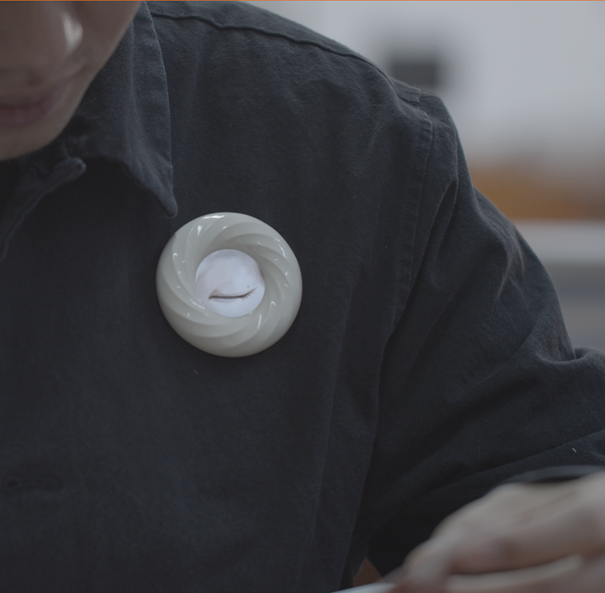
Inspired by traditional brooches symbolizing affection, this work supports long-distance relationships across time zones. Sensors track sleeping heart-rate changes and transform them into visual eye movements displayed on a distant partner's brooch.
This work is inspired by the traditional brooch prototype, symbolizing affection between lovers. Designed for long-distance relationships across time zones, it uses sensors to track heart rate changes during sleep, converting them into visual eye movements displayed on the brooch of the distant partner.
MoodCam: An AI-Supported Camera for Generating Emotional Photography and Poem
Authors:
Rong Fu
Yiyang Liu
China Academy of Art
Leijing Zhou
Supervisor, Zhejiang University
Description:
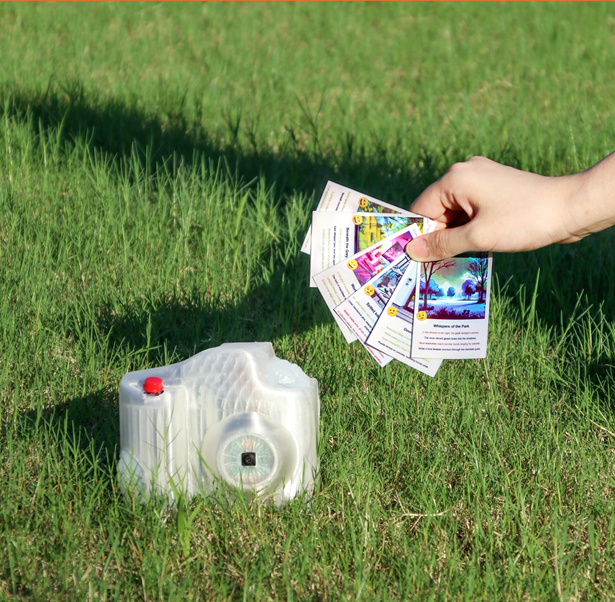
MoodCam is an AI-supported camera using the front camera to capture facial expressions and the rear camera to capture the scene. Based on detected emotion and age, it generates stylized photographs and poems with emotion-driven typography, enriching each captured moment's emotional depth and expression.
MoodCam is an AI-supported camera that uses the front camera to capture users' facial expressions and the rear to capture scenes. Based on the user's detected emotions and age, it generates visually stylized photographs and poems in emotion-driven typography, thereby enriching the emotional depth and expressiveness of each captured moment.
Cultural Fusion
Atlas • Weaving Feather - for Electric Guitar, Electronic Music and Visual
Authors:
Xiaorong Shao
Shanghai Conservatory of Music
Zhaorui Liu
Southern University of Science and Technology
Description:
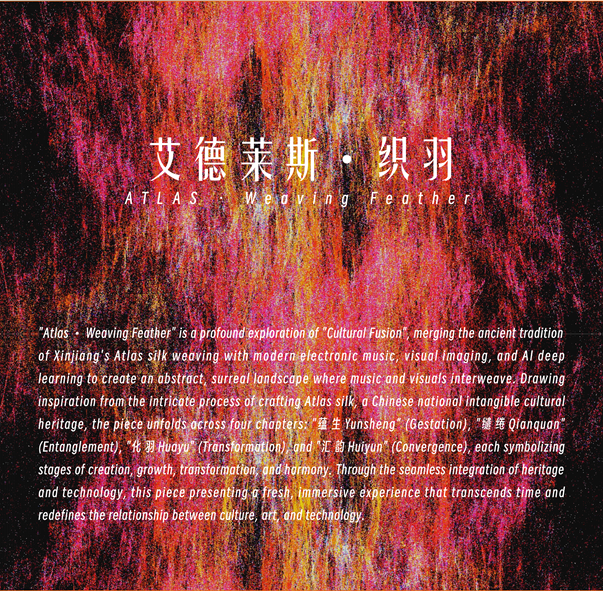
Atlas: Woven Feathers combines Xinjiang's ancient Atlas silk-weaving tradition with electronic music, visual imaging, and AI deep learning, creating an abstract, surreal landscape of intertwined music and imagery. Inspired by the intricate production of Atlas silk, a national intangible cultural heritage, it comprises four chapters: Birth, Entanglement, Transformation into Feathers, and Converging Rhythms.
"Atlas . Weaving Feather" merging the ancient tradition of Xinjiang's Atlas silk weaving with modern electronic music, visual imaging, and Al deep learning to create an abstract, surreal landscape where music and visuals interweave. Drawing inspiration from the intricate process of crafting Atlassilk. a Chinese national intangible cultural heritage, the piece unfolds across four chapters: "Yunshang (Gestation)," "Qianquan (Entanglement)," "Huayu (Transformation)," and "Huiyun (Convergence)."
Winding Stream Party
Authors:
Keshuo Nian
Yuhang Zhang
Yijie Lv
Yibo Jia
Beijing Jiaotong University
Yuan Yao
Jingya Li
Supervisor, Beijing Jiaotong University
Description:
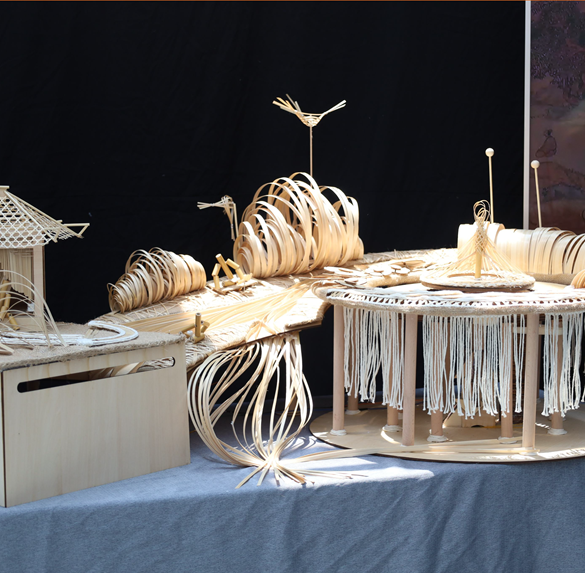
Using automation, bamboo weaving, and figures, we recreate the Shangsi Festival's libation ritual. Combining changing views at every step with Appia's modularity, rhythmic space and bamboo textures express an evolving connection between humans and deities.
We recreate the Shang-si-Festival goblet ritual by using automation, bamboo weaving, and figures. We integrated "one step at a time" and Appia's modularity to convey the evolving connection between humans and gods through rhythmic space and bamboo textures.
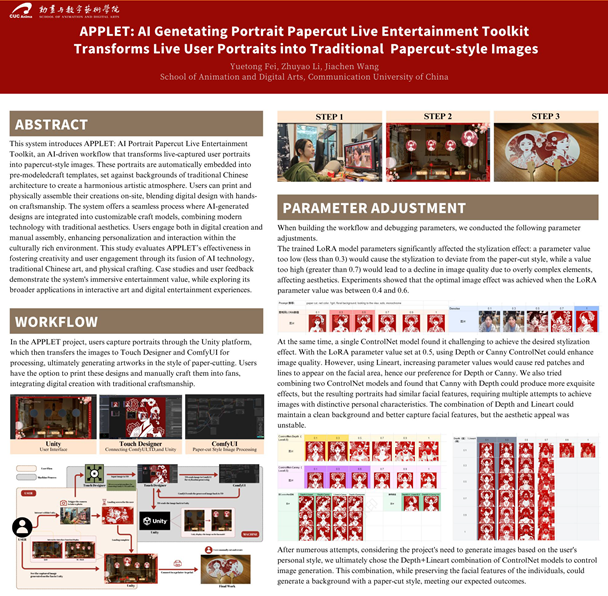
APPLET: AI Portrait Papercut Live Entertainment Toolkit
Authors:
Yuetong Fei
Zhuyao Li
Jiachen Wang
Communication University of China
Zihan Gao
Wenjuan Chen
Guangzheng Fei
Supervisor,Communication University of China
Description:
APPLET: AI Portrait Papercutting Live Entertainment Toolkit is an interactive AI art installation combining traditional papercutting and modern technology. Users create personalized papercut portraits, connecting Eastern aesthetics and innovation and supporting sustainable cultural heritage.
"APPLET: AI Portrait Papercut Live Entertainment Toolkit" is an interactive AI-art installation merging traditional paper-cutting with modern technology. It allows users to create personalized paper-cut portraits, integrating Eastern aesthetics with innovation to foster the sustainable growth of cultural heritage.
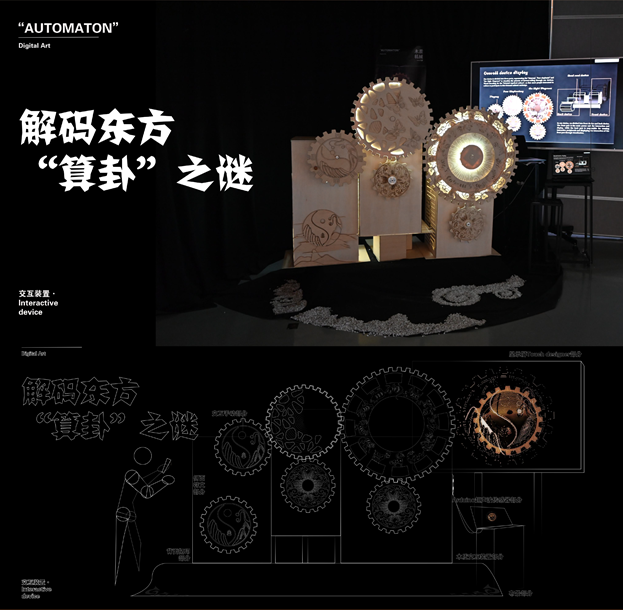
Deciphering . hexagrams
Authors:
Ge Gao
Xiaoyi Dong
Luyang Wang
Yifei Gao
Beijing Jiaotong University
Yuan Yao
Supervisor, Beijing Jiaotong University
Description:
New media art meets Chinese culture and Daoist thought: human–machine collaboration and technological immersion use wood as a medium to revitalize New Year print traditions.
The new media art combines Chinese culture, uses Taoist ideas, links man-machine, employs tech for immersion, with wood, to revive New Year picture culture.
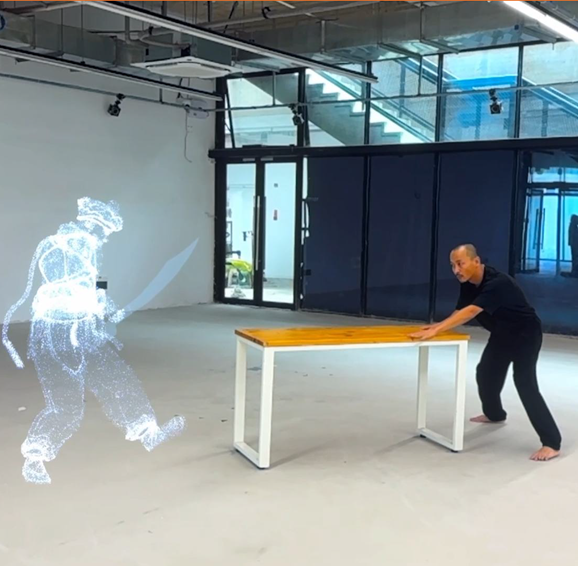
Crossroads-Phantom Opera
Authors:
Kaiqing Huang
China Academy of Art
Qiao Xiao
Xiaoqin Zhou
Xinyue Li
Jiayun Hua
Yihao Zhao
JingJing Zeng
China Academy of Art
Jiaming Wang
TongZhou Yu
Yongru Lu
Supervisor, China Academy of Art
Description:
Crossroads—Phantom Opera is an experimental performance combining augmented reality and Chinese opera. Based on the classic Peking opera At the Crossroads, it explores possibilities for integrating cutting-edge technology with traditional performance.
"Crossroads-Phantom Opera" is an experimental performance that combines augmented reality with opera performance. It explores the possibilities of integrating cutting-edge technology with traditional performances, based on the classic Chinese Peking opera "Crossroads."
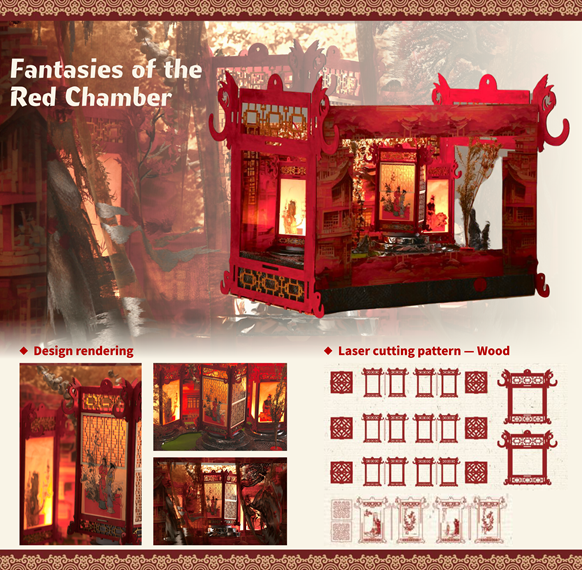
Fantasies of the Red Chamber
Authors:
Yifei Hu
Beijing Jiaotong University
Yuan Yao
Supervisor, Beijing Jiaotong University
Description:
Drawing on Dream of the Red Chamber, this work incorporates love into palace-lantern design, expressing poignant beauty through sorrowful aesthetics and using modern technology to pay tribute to literary heritage.
In A Dream of Red Mansions, love is integrated into the design of the palace lamp, showing the sad beauty with the aesthetics of mourning, and modern technology is reproduced to pay tribute to the literary heritage.
Exiling the Gods
Authors:
Wei Tan
Yingfei Xiong
Zixi Yang
Central Academy of Fine Arts
Tong Lin
Supervisor, Central Academy of Fine Arts
Description:
Exiling the Gods combines AI and VR to explore shamanism's survival within technology through immersive experiences. It asks whether AI embedding ancient knowledge can evoke reflection on divinity and ritual, and whether technology can reproduce or transform spiritual experience.
"Exiling the Gods" combines AI and VR to explore the survival of shamanism within technology through an immersive VR experience. It questions whether AI, by embedding ancient knowledge, can evoke reflections on divinity and ritual, and whether technology can replicate or alter spiritual experience.
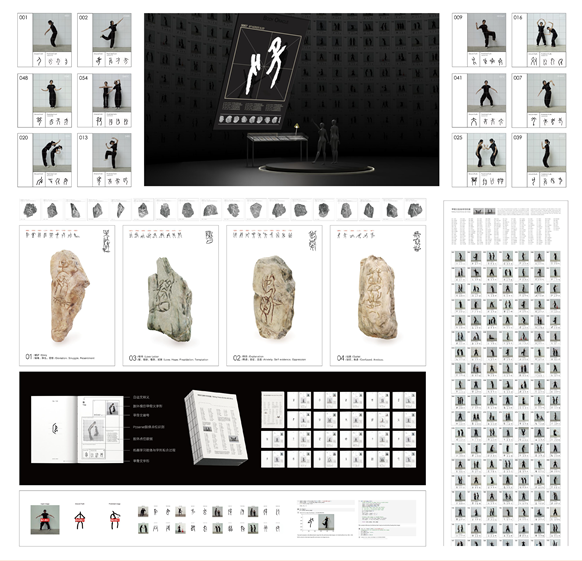
Body Oracle: Speculative Hieroglyphs for Collective Bodily Awareness
Authors:
Ke Huang
Danlin Huang
Academy of Art
Botao Amber Hu
Supervisor, Reality Design Lab
Cun Lin
Supervisor, China Academy of Art
Description:
Although bodily language plays a substantial role in communication, its nuances often go unrecognized in the digital age. Inspired by oracle-bone inscriptions, among China's earliest writing forms, Body Oracle proposes a transformative vocabulary for complex bodily interactions. This speculative design uses AI-generated characters embodying proprioceptive experiences, enabling participants to engage with movement in new ways.
In today's digital landscape, the nuances of body language often go unrecognized, despite comprising a significant portion of our communication. Inspired by Oracle Bone Inscriptions (OBI), one of the oldest forms of Chinese writing, "Body Oracle" proposes a transformative vocabulary for expressing complex bodily interactions. This speculative design employs AI-generated characters that encapsulate proprioceptive experiences, allowing participants to engage with their movements in novel ways.
72 Dimensions
Authors:
Jihui Wang
Xin Tang
Lulin Zhou
Guangzhou Academy of Fine Arts
Qiao Feng
Baoquan Luo
Supervisor, Guangzhou Academy of Fine Arts
Description:
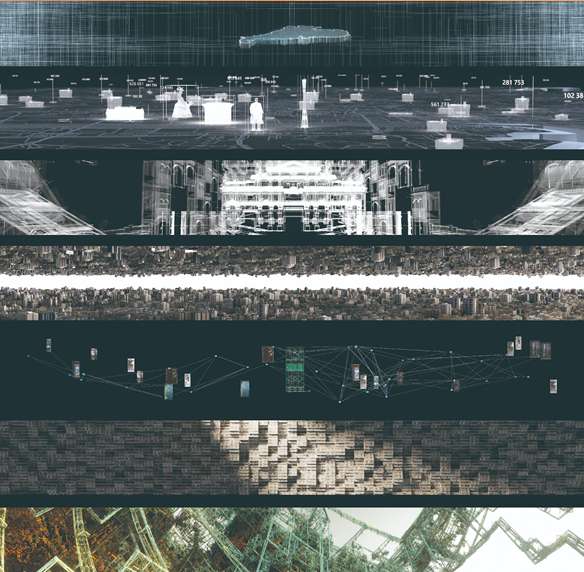
The work uses Lingnan architectural elements to present cultural landscapes through digital media art.
Using Lingnan architectural elements, the work showcases cultural landscapes through digital media art.
Mo Yun Shan Shui-An Interactive Art installation inspired by the Rhyme of Landscape ink Painting
Authors:
Lingyu Peng
Ruoyan Zhu
Harbin Institute of Technology
Zhenglang Jiang
University of Science and Technology Beijing
Kebing Wan
Harbin Institute of Technology
Qingchuan Li
Supervisor, Harbin Institute of Technology
Description:
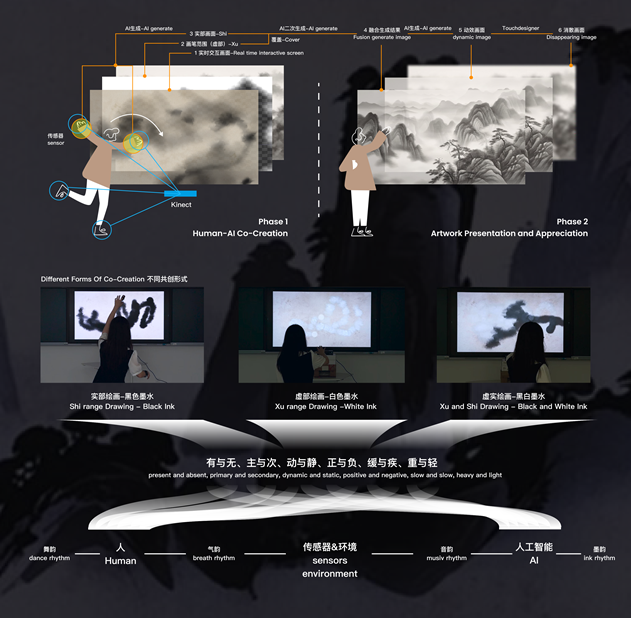
This work divides a landscape painting into real and virtual portions, one created by the user and the other by AI. They merge into a complete animated landscape as the virtual portion evolves dynamically. By allocating painting tasks in human–computer interaction, it demonstrates aesthetic harmony.
This artwork divides landscape paintings into Xu and Shi parts, where the user and AI each create one. The two parts are then merged, with the virtual part dynamically evolving, resulting in a complete animated landscape. Through the allocation of painting tasks in human-AI interaction, the artwork showcases aesthetic harmony.