
Chinese CHI 2024: Concurrent Workshops
Concurrent Workshops
Conference Overview
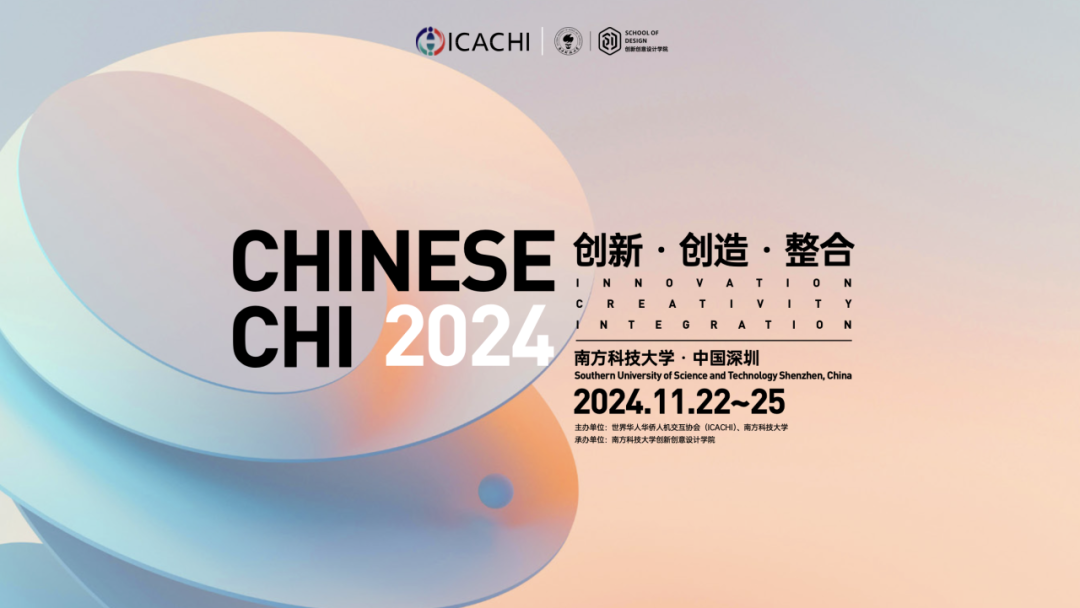
Organized by International Chinese Association of Computer Human Interaction (ICACHI), Chinese CHI 2024 will take place from November 22 to 25, 2024, at Southern University of Science and Technology in Shenzhen, China. Its themes are Innovation, Creativity, and Integration.
Organized by International Chinese Association of Computer Human Interaction (ICACHI), this academic conference has become an important meeting point connecting Chinese HCI researchers, academia, and industry worldwide. Since 2012, Chinese CHI has been held successfully in Paris, Toronto, Seoul, Silicon Valley, Guangzhou, Montreal, Xiamen, and Bali, Indonesia. Conference papers are included in the ACM Digital Library and submitted for EI indexing.
In an era of emerging AI, the conference explores how technological innovation can transform interaction, stimulate creativity, shape more intelligent and human-centered interactive systems, and integrate multidisciplinary research to address complex real-world applications. We warmly invite leading scholars, researchers, and industry figures worldwide to share their latest findings and experience, exchange ideas, and explore diverse ways technology can empower humanity's future.
Already registered participants should scan the QR code at the end of the article to register for workshops. If you have not registered for the conference, first long-press the QR code below.
Conference Registration

(Please scorll down for English)
Workshop 1
A New Tool for Cross-Platform Interaction Innovation
Time: November 22, 9:00 am–12:00 pm
Venue: Room 1002, Building C1, Nanshan Zhiyuan, Shenzhen
Language: Chinese
Equipment Requirements: None
Using practical cases, this workshop introduces the research and applications of interaction design languages. Through the new IxDL card game and interactive demos, participants learn foundational concepts, broaden their understanding of interaction mechanisms, and reflect on interaction design's granularity. Groups then play two or three rounds of the IxDL game, exploring different approaches and insights, consolidating their understanding of new concepts and paradigms, and improving their perceptiveness, creativity, and efficiency in cross-platform interaction design.
Target Audience:
- Interaction and experience designers, product managers, front-end developers, human–computer interaction researchers, and students
Expected Outcomes:
- Discover new perspectives and ways of thinking about interaction design
- Learn new methods and tools for interaction-mechanism innovation through the IxDL card game
- Develop the ability to identify and create cross-platform interactions
- Improve communication within design teams and between designers and developers

Speaker: Luo Tao
Luo Tao is an assistant professor in Southern University of Science and Technology's School of Design, a Guangdong Pearl River Talent Plan outstanding young talent, and recipient of Southern University of Science and Technology's teaching excellence award. As a practitioner, researcher, and educator, he studies interaction's underlying logic, prototypes, and formal descriptions. Professor Luo Tao holds a bachelor's in mathematics and applied mathematics from Sun Yat-sen University and master's and doctoral degrees in interaction design from Kookmin University, South Korea. He was an assistant professor at Kookmin and UX design manager at SK Telecom, designing smartphone, smartwatch, and in-vehicle interactions. Professor Luo Tao authored Interaction Design Language: The Art of Conversing with Everything and Universal Interaction Gesture Dictionary, widely shared and praised by designers at technology companies on platforms including Xiaohongshu, with some content incorporated into major companies' design guidelines. Principal inventor of sixteen Chinese, US, and Korean patents, he innovates interaction mechanisms for touchscreens, physical interaction, spatial computing, and other platforms. Since 2019, he and his students have filed over fifty patents at universities and companies using the interaction design language and its tools. He developed related card games, editors, and prototyping tools to improve learning and application. His undergraduate DS322 User Experience and Interaction course at Southern University of Science and Technology's School of Design averages three student patent applications each semester. He has provided talks and training at Huawei, NetEase, Microsoft, Lenovo, Midea, and Frog, improving designers' innovation capabilities and efficiency.
Workshop 2
Possibilities of Bio-HCI: Exploring Future Scenarios for Bio-HCI Innovation
Time: November 22, 9:00 am–12:00 pm
Venue: Room 1108, Building C1, Nanshan Zhiyuan, Shenzhen
Language: English/Chinese
Equipment: Laptop and Mobile Phone
Advances in science and technology have made the integration of biology and human–computer interaction (HCI) an emerging and promising research direction, creating biological human–computer interaction (Bio-HCI). Bio-HCI uses innovative biotechnology, biosensors, and biomaterials to redefine relationships among humans, living organisms, and computers through biodesign, investigating how these interactions can be supported and enhanced. This workshop offers an open discussion space to understand Bio-HCI's foundations, trends, and leading examples. Participants will apply these concepts in design exercises, generate interaction models, and discuss future applications and possibilities, encouraging innovation across fields.
Target Audience:
- Design students, interaction designers, artists, and human–computer interaction (HCI) researchers interested in Bio-HCI
- Engineers and scientists interested in interdisciplinary research and innovation
- Students interested in Bio-HCI
Expected Outcomes:
- Understand new research directions in human–computer interaction (HCI)
- Understand Bio-HCI trends, application methods, and tools and technologies, including sensors and IoT
- Strengthen interdisciplinary collaboration and communication in design teams
- Inspire broad reflection on future Bio-HCI innovations and applications
- Experiment with Bio-HCI design concepts

Speaker: Christiane Herr
Christiane Herr is a professor and doctoral supervisor at Southern University of Science and Technology's School of Design, its teaching lead, and director of the Bachelor of Industrial Design program. Holding doctorates in architecture and engineering, she founded the Future Ecologies Research Group, which investigates interdisciplinary ecological research and design, advanced facade technologies, and digitally supported design. She earned an engineering master's at the University of Kassel, an architectural master's and doctorate at the University of Hong Kong, and a second doctorate in engineering at Kassel. Before Southern University of Science and Technology, she was associate professor at Xi'an Jiaotong-Liverpool University and Shenzhen University and visiting assistant professor at National Cheng Kung University. She served four years as CAADRIA president and is vice chair of the CAADFutures Foundation committee and an editorial board member of the International Journal of Architectural Computing and Sustainable Horizons. She has published over 100 peer-reviewed works. Her recent co-edited book Design Cybernetics: Navigating the New was published in Springer's Design Research Foundations series.
Workshop 3
How Will We Grow Old? Cultivating Intergenerational Awareness of Aging
Time: November 22, 9:00 am–12:00 pm
Venue: Room 1009, Building C1, Nanshan Zhiyuan, Shenzhen
Language: English/Chinese
Equipment Requirements: None
This workshop explores younger generations' attitudes toward older adults and cultivates empathy through interactive activities. After an introduction, experiential exercises develop physical and emotional empathy with older people. Participants then brainstorm collaboratively to identify key challenges in intergenerational understanding. Finally, small groups develop innovative strategies and potential technology-assisted solutions to address these challenges effectively.
Target Audience:
- Design students and early-career researchers interested in aging
- Young volunteers, social workers, and care professionals with experience supporting older adults
- Young people interested in aging societies
Expected Outcomes:
- Through experiential activities, participants gain deeper understanding of older adults' physical and emotional challenges. Using the provided tools and methods, they will identify real challenges in older communities and develop empathetic, context-sensitive strategies, potentially supported by technology.

Speaker: Mirna Zordan
Mirna Zordan is an assistant professor at Southern University of Science and Technology's School of Design, an architect, and a design researcher interested in urban psychology and environmental behavior under complex conditions. Responding to Sustainable Development Goals concerning mental health and social and environmental sustainability, she develops design responses to future urban density through dialogue among practitioners, academics, and multidisciplinary specialists. She earned bachelor's and master's degrees and architectural licensure at IUAV University of Venice, followed by a PhD at City University of Hong Kong supported by the Hong Kong PhD Fellowship Scheme. After practicing architecture in Sydney, she taught as an invited lecturer at IUAV, Atelier Europe China IUAV/CAUP Tongji University and Tongji University, FAB Fabrica de Ciudad in Mexico City, City University of Hong Kong, the University of Hong Kong, and Arup Hong Kong. In Venice, she researched the National Industry 4.0 project funded by the European Social Fund with IUAV, RE-VEGA Group, Venice Science and Technology Park, the Veneto Region, and Ca' Foscari University. Before joining Southern University of Science and Technology, she worked at the University of Hong Kong and was active in the International Forum on Urbanism's YA team. More information: https://www.mirnazordan.com

Speaker: Wanlin Zhang
Wanlin Zhang is an assistant professor at Southern University of Science and Technology's School of Design, researching cultural digitalization, sustainable design, and digital humanities. She holds a bachelor's in industrial design from Central South University, master's in design from Hunan University, and PhD in design from Lancaster University. Before Southern University of Science and Technology, she was a researcher on a UK Arts and Humanities Research Council-funded project and an assistant on Cultural Exchange. Her ongoing projects explore technologies and design innovation for collecting, analyzing, and transforming cultural data. She publishes in The Design Journal, International Journal of Anthropology and Ethnology, IEEE and Springer publications, and leading Chinese journals; presents at major design conferences; and reviews for international cultural and design journals and conferences. Applied and university–industry projects have given her experience in user research, product development, and project management. Her earlier designs won national, provincial, and municipal awards and patents. More information: https://resilientculturedesign.github.io/

Speaker: Xueliang Li
Xueliang Li is an assistant professor at Southern University of Science and Technology's School of Design. His research covers human–computer interaction design, human–social robot interaction, emotion-driven design, and design for well-being. Using design as research, he develops prototypes and studies user experience in laboratories and real-world settings to understand technological innovation in everyday life and industry and extend interdisciplinary design research. Before joining Southern University of Science and Technology's School of Design, he received his PhD from Delft University of Technology's Faculty of Industrial Design Engineering. More information: https://www.hci-xgroup.com/
Workshop 4
Exploring Physiological Sensing as Embodied Cues to Enhance Co-Presence in the Metaverse
Time: November 22, 9:00 am–12:00 pm
Venue: Room 1107, Building C1, Nanshan Zhiyuan, Shenzhen
Language: English/Chinese
Equipment: Laptop or Tablet
This research uses psychophysiological information as embodied social cues to enhance large-scale co-presence in the metaverse, exploring people's perceptual preferences for different physiological data and representations. Each participant experiences a VR DJ performance incorporating five signals collected from real baseline users: electromyography (pEMG), galvanic skin response (GSR), heart rate (HR), respiration intensity (RE), and oxygen saturation (SpO2). After trying the prototype, participants complete an online survey about their preferences for the granularity and forms of physiological data representation, informing subsequent research and design decisions.
Target Audience:
- Participants interested in human–computer interaction, VR devices, metaverse social interaction, physiological signal representation, and VR games are welcome.
Expected Outcomes:
- Participants will learn about different physiological signals and their effects on physiological synchrony and perceived co-presence, and experience a metaverse environment integrating physiological data. Their feedback will inform future research and design.

Speaker: Ruowei Xiao
Her research lies at the intersection of design and human–computer interaction, particularly IoT-based embodied interaction, extended reality, and gamification. She has first-authored papers in leading human–computer interaction and gaming venues including IJHCI and CHI Play. She holds a bachelor's in information security engineering and a second bachelor's in animation from Shanghai Jiao Tong University, followed by master's and doctoral degrees in media design at Keio University, supported by a Japanese government MEXT scholarship. Before joining Southern University of Science and Technology, she was a postdoctoral researcher in Tampere University's Gamification Group. An independent game developer with industry experience, she also worked at Japan's Koei Tecmo.
Workshop 5
Urban Soundscapes: Interactive Data Visualization of Urban Sound Diaries
Time: November 22, 9:00 am–12:00 pm
Venue: Room 1011, Building C1, Nanshan Zhiyuan, Shenzhen
Language: English/Chinese
Equipment: A Fully Charged Mobile Phone
This workshop guides participants in exploring and manipulating urban sound data using the Urban Sound Diary application.
The Sound Research Group is co-led by Marcel Zaes Sagesser, who earned his PhD at Brown University in 2021 and is an assistant professor at Southern University of Science and Technology's School of Design. His sound and technology research focuses on physical acoustic matter, algorithms, and interactions between humans and technology.
Target Audience:
- Researchers, urban planners, media artists, and practitioners interested in urban studies, data visualization, sound studies, mobile technologies, and interaction technologies
Expected Outcomes:
- Learn about the Urban Sound Diary application and its features
- Acquire theoretical knowledge of audio analysis
- Explore urban soundscapes creatively through interactive data visualization
- Understand and discuss data's significance in urban studies, sound studies, human-centered technology, interaction design, and social computing
- Provide feedback on the application's usability and features to inform improvements
Speaker: Xuehua Fu
Xuehua Fu is a computer science researcher specializing in human-centered computing and a research assistant at Southern University of Science and Technology's School of Design. She holds a master's in computer science from Sweden's KTH Royal Institute of Technology and a bachelor's in information and computational science from Sun Yat-sen University. Her interests include sound and music computing, multisensory perception, and human–computer interaction. Xuehua Fu joined the Sound Research Group in July 2024, participating in and leading the Big Sound project on large-scale urban environmental sound data. She led the development of Urban Sound Diary, an application using data visualization to understand urban sounds.
Workshop 6
Future Archaeology: Experiencing, Discussing, and Testing Living Archives Through Hakka Culture
Time: November 22, 9:00 am–12:00 pm
Venue: Room 1012, Building C1, Nanshan Zhiyuan, Shenzhen
Language: English/Chinese
Equipment: Participants Are Encouraged to Bring a Laptop
Shenzhen, a dense and dynamic city in southern China, exemplifies rapid urban transformation and development. Since its rise in the 1980s, rather than developing a collective memory, it has reflected the individual stories of people seeking opportunities from across the country.
Future Archaeology, a research project by the Materialities Research Group at Southern University of Science and Technology's School of Design, treats the city as a future archaeological site. It questions conventional historical reconstruction in our rapidly changing, connected society, combining community engagement and co-design with digital tools and AI to reconstruct both fact and fiction.
We propose a speculative Living Archive to challenge and reimagine the exploration and accessibility of cultural heritage, ultimately offering a participatory approach to urban archaeology. Engaging with tangible real materials and digital technologies, we question conventional narratives and reject singular perspectives. Using open-source APIs and web technologies, we develop a virtual realm connecting dispersed materials and stories, including regenerated data.
Focusing on Hakka culture in Shenzhen's Pingshan community, we seek to reveal hidden narratives and material dimensions through technological integration. Collaborative and speculative strategies connect history with present and future identities and actions, offering insights into interaction design, ethnography, applied computing, and human–computer interaction.
As part of the broader Future Archaeology project, we designed a web platform as a living archive of Hakka culture. It enables the public to explore a fictional historical space reconstructed from real remains, collected stories, community ideas, and AI tools generating text, 2D images, and 3D objects, through personalized rather than imposed narratives. Further development incorporates public comments, feedback, knowledge, and stories into cultural heritage that continually evolves and is never fixed.
Target Audience:
- Researchers, practitioners, and students in design, media art, cultural heritage, social computing, AI, and technology, and anyone interested in material culture, urban studies, community participation, and narrative methods and practices
Expected Outcomes:
- Explore and interact with the virtual space
- Contribute ideas and feedback to improve the participatory archive
- Experience being an active agent of cultural and material transformation
- Engage in creative conversations about the future of technology, cultural heritage, and materials
- Learn about Hakka culture

Speaker: Enza Migliore
Enza Migliore
Enza Migliore is an assistant professor at Southern University of Science and Technology's School of Design and heads its Materialities Research Laboratory, which investigates materials through ecology, technology, and culture using interdisciplinary, empirical design practices. She holds a PhD in design and innovation from the Second University of Naples and received a JSPS postdoctoral fellowship (2017-2019). Her interests are materials and design, bio-innovation, and ecologically intelligent design. At Tokyo Metropolitan University, she explored critical perspectives on material futures. International exhibitions form part of her dissemination activities. She is a visiting researcher at IPCB—the Italian National Research Council's Institute for Polymers, Composites and Biomaterials—Foamlab at the University of Naples Federico II, and the Hybrid Design Laboratory, and co-chairs the Cumulus REVEDA working group.
Workshop 7
Creating Creation: Building Multimodal Agents for AIGC with GenFlow
Time: November 22, 9:00 am–12:00 pm
Venue: Room 1003, Building C1, Nanshan Zhiyuan, Shenzhen
Language: Chinese
Equipment: Laptop
As generative capabilities evolve and algorithms become products, generative AI agents have become essential creative tools. They generate images, video, speech, text, and other multimodal content, providing inspiration and practical outputs. Creation is a complex, multistage process involving repeated divergent and convergent thinking. Progress toward creative goals requires multiple rounds of iterative interaction with agents.
We propose GenFlow, a multimodal human–agent collaborative framework for complex creative tasks. By providing explainable, controllable interfaces in multiple modalities at different creative stages, it improves both experience and quality in tasks such as picture books, narrative comics, animated posters, and meeting records. The workshop introduces GenFlow and uses case studies and hands-on practice to explore, refine, and extend human–agent creative collaboration.
Hands-on activities comprise three design and research tasks: (1) using an agent-building platform and GenFlow to construct creative agents with multimodal AI capabilities for images, video, speech, and text; (2) producing high-quality creative work with those agents; and (3) cross-evaluating the results and discussing GenFlow's possibilities for multimodal human–agent collaboration.
The workshop offers scholars, practitioners, and enthusiasts in design, creativity, and interdisciplinary fields a useful reference and practical platform for design thinking and innovation in the GenAI era.
Target Audience:
- Teachers and students with introductory experience in intelligent design, creative design, AIGC, AI, large models, or related fields are welcome, as are practitioners, independent creators, and creative media content producers.
Expected Outcomes:
- Understand the concepts, principles, and architecture of GenFlow's human–agent creative collaboration framework
- Learn methods and tools for building agents that match users' creative needs and behavior, and create working examples
- Collect and integrate participants' discussions to guide further improvements to GenFlow and its practical value in multimodal human–AI collaboration, while encouraging deeper academic and industry research and discussion

Speaker:
Innovation Center, Alibaba Cloud Intelligent Design Department
If you have registered for the conference, long-press the QR code below to register for workshops.
Workshop Registration

Industry Presentation
Innovative Applications of Multimodal Neurotechnology in Intelligent human–computer interaction
Session 1: Time and Venue
- November 22, 8:30 am–8:50 am
- Room 1014, Building C1, Nanshan Zhiyuan, Shenzhen
Session 2: Time and Venue
- November 23, 13:30 pm–13:50 pm
- Room 108, Business School Building, Southern University of Science and Technology Main Campus
Language: Chinese
Equipment Requirements: None
Topics include:
- Concepts for applying multimodal neurotechnology in intelligent human–computer interaction
- Technical methods for multimodal neurotechnology in intelligent human–computer interaction
- Case studies of multimodal neurotechnology in intelligent human–computer interaction
Speaker: Shuo Wang
Regional director at Beijing Everloyal Technology Co., Ltd. and Zhongke (Guangdong) Science Group Co., Ltd., and department head at the Wuhan Human Factors Engineering Research Institute and Guangdong Human Factors Technology Research Institute. With expertise in human factors engineering and cognitive neuroscience, he combines visual, auditory, olfactory, gustatory, tactile, acoustic, light, electrical, and magnetic stimulation with eye tracking, EEG, near-infrared, and MRI technologies. Applications span psychological human factors, transportation and driving, industrial design, virtual reality, and defense.
Concurrent Workshops
Conference Introduction
The International Chinese Association of Computer Human Interaction (ICACHI) is delighted to announce the upcoming Chinese CHI 2024 conference will occur in Southern University of Science and Technology, Shenzhen, China, from November 22th to 25th, 2024. The conference theme for this year is "Innovation. Creativity. Integration."
Chinese CHI is the premier venue for connecting Chinese HCI researchers, practitioners, and industry leaders worldwide. Since its inception in 2012, Chinese CHI has successfully been held in Paris, Toronto, Seoul, Silicon Valley, Guangzhou, Montreal, Xiamen, and Bali. Accepted papers at the conference are published annually in ACM Digital Library and EI Compendex.
In the era of emerging technologies, Chinese CHI 2024 will focus on driving transformations in interaction paradigms through technological innovation, stimulating creativity to shape more intelligent and human-centered interactive systems, and integrating multidisciplinary research outcomes to address complex real-world application scenarios. We cordially invite leading scholars, researchers, and industry leaders from around the globe to share their latest findings and practical experiences, to foster intellectual exchange and collaborative dialogue, and to explore diverse pathways through which technology can empower the future of humanity.
For those who have registered for the conference, please scan the QR code at the end of the article to register for workshops; for those who have not yet registered for the conference, please scan the QR code below to register for the conference first.
Register for the Conference
Workshop 1
A New Tool for Cross-Platform Interaction Innovation
Date and Time: Oct. 22nd, 9:00 am -12:00 pm
Location: Room 1002, Building C1, iPark SUSTech School of Design
Language: Chinese
Equipment Requirement: N/A
This workshop will introduce the research and application background of interaction design language using real-life cases. Through the new tool “IxDL Card Game" and a series of interaction demos, it will cover the basic concepts of interaction design language, broaden participants' understanding of interaction mechanisms, and encourage deeper thinking about the granularity of interaction design. Participants will then play 2-3 rounds of the "IxDL Card Game" in groups to experience different gameplay and insights, solidifying their understanding of new concepts and paradigms in interaction design, and enhancing their perception, innovation, and efficiency in cross-platform interaction design practices.
Target Audience:
- Interaction designers, experience designers, product managers, front-end developers, human-computer interaction researchers, and students.
Participant Benefits:
- Gain a new perspective and way of thinking in interaction design.
- Learn new methods and tools for innovation in interaction mechanisms through the "IxDL Card Game."
- Develop the ability to discover and create cross-platform interaction methods.
- Improve communication efficiency within design teams and between design and development teams.
Host: Luo Tao
Luo Tao is an assistant professor at the School of Innovation and Design, Southern University of Science and Technology. He is a recipient of the Guangdong “Zhujiang Talent Plan” for young talents and has received the university's Teaching Excellence Award. As a practitioner, researcher, and educator in interaction design, he focuses on the fundamental logic, prototypes, and formal methods of describing interaction. Luo Tao graduated with a degree in Mathematics and Applied Mathematics from Sun Yat-sen University, and later obtained his master's and doctoral degrees in Interaction Design from Kookmin University in Korea. He has served as an assistant professor at Kookmin University and as a UX Design Manager at SK Telecom, working on interaction design for smartphones, smartwatches, and in-car applications.
Luo Tao is the author of Interaction Design Language: The Art of Dialoguing with Everything and Universal Interaction Gesture Dictionary, which have been widely shared and praised on social networks like Xiaohongshu by interaction designers from many tech companies. Some of his work has been included in design standards of major firms. As the primary inventor of 16 invention patents across China, the U.S., and Korea, his innovations focus on interaction mechanism innovations across various platforms, including touch devices, physical interactions, and spatial computing. Since 2019, he and his students have applied for over 50 invention patents in both academic and corporate settings, based on interaction design languages and tools. He developed card games, editing tools, and prototyping tools based on this language, enhancing the efficiency of learning and application. At Southern University of Science and Technology, he teaches the undergraduate course “DS322 User Experience and Interaction”, leading students to apply for an average of three invention patents each semester. He has been invited to share and conduct training at renowned companies such as Huawei, NetEase, Microsoft, Lenovo, Midea, and Frog, further enhancing the innovation capabilities and efficiency of corporate designers in interaction design practices.
Workshop 2
Possibilities of Bio-HCI: Exploring Future Scenarios of Bio-HCI Innovation
Date and Time: Oct. 22nd, 9:00 am -12:00 pm
Location: Room 1108, Building C1, iPark SUSTech School of Design
Language: English/Chinese
Equipment Requirement: Laptop, Cellphone
With the development of science and technology, the integration of biology and human-computer interaction (HCI) has become an emerging and promising research direction, leading to the development of the new research direction of Bio-HCI. Bio-HCI uses innovative biotechnology, biosensors and biomaterials to redefine the relationship between humans, organisms, and computers through bio-design and examines ways in which such interaction experiences can be supported and enhanced. This workshop aims to provide participants with an open-ended discursive space to understand the basic concepts, trends, and cutting-edge cases of Bio-HCI. At the same time, the workshop will guide participants to experiment with these concepts in a design exercise to generate new interaction models and to discuss the future application scenarios and possibilities of Bio-HCI in order to promote the innovative application of Bio-HCI in different fields.
Target Audience:
- Design students, interaction designers, artists and HCI researchers with an interest in Bio-HCI topics
- Engineers and scientists with cross-disciplinary research and innovation interests
- Students with an interest in the Bio-HCI
Participant Benefits:
- Understand new research directions of human-computer interaction.
- Understand the development trends, application methods and tools/technologies of Bio-HCI (sensors, IoT etc).
- Enhance the design team's ability to collaborate and communicate across disciplines.
- Inspire participants to think extensively about the future innovation and application scenarios of Bio-HCI.
- Experimental design Bio-HCI design concepts.
Host: Christiane Herr
Christiane M. Herr is Professor and PhD supervisor as well as responsible person for education and Director of the BEng Industrial Design program at the School of Design, Southern University of Science and Technology. With a background in architecture and engineering, Christiane leads the Future Ecologies Research Group with a focus on the areas of cross-disciplinary ecological design, advanced façade technologies and digitally supported design. Christiane obtained a Dipl.-Ing. degree from the University of Kassel, an MArch and Ph.D. degrees from The University of Hong Kong and a second Dr.-Ing. degree from the University of Kassel. Before joining SUSTech, she held positions as Associate Professor at Xi’an Jiaotong-Liverpool University and Shenzhen University and as Visiting Assistant Professor at National Cheng Kung University. Christiane was President of the Association for Computer-Aided Architectural Design Research in Asia (CAADRIA) for four years and is currently vice-chair of the Board of the CAADFutures Foundation. She is a member of the editorial boards of the Journal of Architectural Computing (IJAC), the journal Architectural Intelligence and the journal Sustainable Horizons. Herr has authored over 100 peer reviewed academic publications and has recently co-edited the book “Design Cybernetics: Navigating the New”, published in the Springer Design Research Foundations Series.
Workshop 3
Aging with Empathy: Fostering Cross-Generational Insights into the Aging Experience
Date and Time: Oct. 22nd, 9:00 am -12:00 pm
Location: Room 1009, Building C1, iPark SUSTech School of Design
Language: English/Chinese
Equipment Requirement: N/A
This workshop is designed to explore younger generations’ attitudes toward the elderly and to
foster empathy through a series of interactive activities. The session will begin with an
introduction overview, followed by experiential activities aimed at cultivating both physical and
emotional empathy for the elderly. Building on these insights, participants will engage in a
collaborative brainstorming session to identify key challenges in bridging generational
understanding. Finally, participants will break into smaller groups to develop innovative
strategies and potential technology-assisted solutions for addressing these challenges
effectively.
Target Audience:
- Design students and junior researchers with an interest in aging-related topics.
- Young volunteers and social workers with experience in elderly care, as well as
- practitioners in eldercare services.
- Young people with an interest in the aging society.
Participant Benefits:
- Participants will gain a deeper understanding of the physical and emotional challenges faced by the elderly through our experiential sessions. Also, by using the tools and methods provided, participants will learn to identify real challenges within the elder community and develop empathy-driven, context-appropriate, and potentially technology-assisted strategies to address these issues.
Host: Mirna Zordan
Mirna Zordan is an architect and a design instructor with a specific focus on data-driven spatial psychology and environment-behaviour performances in complex conditions. Her research replies to the SDGs agenda for good health and well-being and her current projects are centered on 1) psycho-physiological responses to high-density space complexities with a specific focus on stress levels, and 2) human-environment interactions for the aging society. She also has an active interest in exploring design responses for urban villages (Villages in the City) through increased dialogues among local communities and authorities, professional practices, scholars, and multidisciplinary experts. Professor ZORDAN received her BA and MA at IUAV The University of Venice together with her license for practicing Architecture. She holds a PhD from City University of Hong Kong awarded with the Hong Kong PhD Fellowship Scheme (HKPFS). After working as an architect in Sydney, she taught and was an invited lecturer in several international institutions including IUAV The University of Venice, Atelier Europe China IUAV/CAUP Tongji University, FAB Fabrica De Ciudad (Mexico City), City University of Hong Kong, The University of Hong Kong, and ARUP Hong Kong. She was also a research fellow in Venice funded by the European Social Funding Scheme replying to the National Industry Plan 4.0, Italy, with IUAV, RE-VEGA Group, The Science and Technology Park of Venice, Regione Veneto, and Universita’ Ca’ Foscari Venezia. Before joining SUSTech, she was working at The University of Hong Kong while being an active ambassador at the International Forum on Urbanism (IFoU). For more information, please see: https://www.mirnazordan.com
Host: Wanlin Zhang
Wanlin Zhang, assistant Professor at the School of Design, Southern University of Science and Technology. She is a cross-disciplinary design researcher whose work focuses on culturally significant design, design for sustainability, and digital humanities. She holds a PhD in Design from Lancaster University, UK, and MA degree in Design Science from Hunan University, China, and BA in Industrial Design from Central South University, China. Her previous research contributes to Located Making project, which is a collaborative three-year project funded by the UK Arts and Humanities Research Council (AHRC) Newton Fund. Also, she previously worked as Assistant to the Cultural Exchange project at Lancaster University. Her ongoing projects investigate how computing technologies and data-driven design approaches can facilitate innovation within cultural and creative fields. She has published almost 20 peer-reviewed articles, book chapters and conference papers, and these include The Design Journal, International Journal of Anthropology and Ethnology, IEEE, EAD conference, IASDR conference, and CUMULUS conference. She also serves as a reviewer for several leading international journals and conferences in culture and design fields. In addition, as a designer and design researcher, she was involved in several design projects and funded research projects, and she has research and commercial experience in user experience research, product development and project management. Her previous design works were awarded at the national, provincial, and municipal levels and were granted patents. More information can be found at https://resilientculturedesign.github.io/
Host: Xueliang Li
Xueliang Li, assistant professor at the School of Design, Southern University of Science and Technology. His research interest lies in Human-computer Interaction (HCI), Human-robot Interaction (HRI), emotion-driven design, and design for mental wellbeing. His research takes on a Research-through-Design perspective, seeing design activities as a way of advancing our understanding of innovative applications of technologies in our everyday life and design practice. Through engaging in design practice and research, he aims to extend the boundaries of the intersections of design and other disciplines. Before joining the School of Design, he obtained his PhD from the Faculty of Industrial Design Engineering at Delft University of Technology in the Netherlands. For more information, please visit: https://www.hci-xgroup.com/
Workshop 4
Exploring Biosensory Information as Embodied Social Cues for Enhancing Metaverse Copresent Experience
Date and Time: Oct. 22nd, 9:00 am -12:00 pm
Location: Room 1107, Building C1, iPark SUSTech School of Design
Language: English/Chinese
Equipment Requirement: Laptop/Pad
This study aims at leveraging people's psychophysiological informationas metaverse social embodied cues to enhance large-scale co-occurringexperiences. To this end, we intend to explore and reveal people'scognitive preferences for various types of biosensory signals and theircorresponding expressions. We will guide each participant to experience aDJ performance in a VR environment that incorporates five biosensorysignals: power of electromyography (pEMG), galvanic skin response(GSR), heart rate (HR), respiration effort (RE), oxyhemoglobinsaturation by pulse oximetry (SpO2), captured from a real baseline user. After experiencing this technical demo, we will inviteusers to participate in an online survey so as to gain first-hand feedbackand elicit user preferences on biosensory information as embodied cues.These feedback will support our subsequent research and future designdecisions.
Target Participants:
- People interested in human-computer interaction, VR devices, metaversesocialization, physiological signal expression, and VR gaming
Participant Benefits:
- Participants will be introduced to different biosensory cues and theirrespective impacts on physiological synchrony and user-perceivedcopresence. They can go through a metaverse co-presence virtualexperience that incorporates biosensory information. Participants'feedback will contribute to our future research and design.
Host: Ruowei Xiao
Ruowei Xiao is Assistant Professor at the School of Design, Southern University of Science and Technology. Her research has been focused on the interdisciplinary domain of design and human computer interaction (HCI), specifically, IoT-based embodied interaction, extended reality and gamification. She has a growing record of first-authored papers published in top HCI and gamification journals and conferences, such as IJHCI and CHI Play.
Previously, she obtained a B.E of Information Security Engineering and a B.A of Animation Production from Shanghai Jiao Tong University. After that, she acquired a MEXT scholarship from the Japanese government and continued her graduate study at Keio University, Japan, where she obtained her M.S and Ph.D of Media Design. Prior to joining SUSTech, she worked as a post-doctoral researcher at the Gamification Group of Tampere University, Finland. In addition, she is also an Indie Game developer and has worked for one of the major Japanese game manufacturers, KOEI TECMO Games.
Workshop 5
Exploring Urban Soundscapes: Interactive Data Visualization with ‘Urban Sound Diary’
Date and Time: Oct. 22nd, 9:00 am -12:00 pm
Location: Room 1011, Building C1, iPark SUSTech School of Design
Language: English/Chinese
Equipment Requirement: A charged personal smartphone with a stable mobile internet connection
This workshop seeks to engage participants in exploring and manipulating urbansound data utilizing the Urban Sound Diary application.
The project PI is Marcel Sagesser. Marcel Sagesser (PhD ‘21 Brown University) is an assistant professor at the SUSTechSchool of Design and is a sound and technology researcher, focusing on physical sonicmatter, algorithms, and interactions between humans and technology. He is the co-directorof the Sound Studies Group.
Target Audience:
- Researchers, urban planners, media artists, and practitioners interested in urbanstudies, data visualization, sound studies, mobile technologies, and interactivetechnologies.
Participant Benefits:
- Be introduced to the ‘Urban Sound Diary’ application and itsfunctionalities.
- Acquire the relevant theoretical knowledge of audio analysis.
- Be encouraged to explore the urban soundscape through interactive datavisualization in a creative manner.
- Gain insight into, and engage in discussionsregarding the implications of the data in urban studies, sound studies, human-centered technology, interaction design, and social computing.
- Provide feedbackon the application’s usability and features for future enhancements.
Host: Xuehua Fu
Xuehua is a computer science researcher specialized in human-centered computing. She holds a MSc degree in Computer Science from KTH Royal Institute of Technology, Sweden, and a BSc degree in Information and Computing Science from Sun Yat-Sen University. Her current research interests include sound and music computing, multisensory perception, and human-computer interaction. Xuehua joined the Sound Studies Group in July 2024. She has been leading the development of the research project “The Big Voice” about data-driven studies of urban sounds in Shenzhen, in which the app ‘Urban Sound Diary’ was created.
Workshop 6
Future Archeology: Experiencing, Discussing, and Testing the Living Archive on the Example of Hakka Culture
Date and Time: Oct. 22nd, 9:00 am -12:00 pm
Location: Room 1012, Building C1, iPark SUSTech School of Design
Language: English/Chinese
Equipment Requirement: Participants are encouraged to bring their own pc for a smooth and effective working session
Shenzhen, a high-density, dynamic city in southern China, showcases the swift transformation and developing character of urban areas. Since its emergence in the 1980s, it has not formed a collective memorybut rather reflects individual narratives from people across the country in search of opportunities.
The research project “Future Archaeology,” conducted by the Materialities Research Group at SUSTechSchool of Design, assumes the city is a future archaeological site. This raises questions about the effectiveness of conventional historical reconstruction methods in our rapidly changing, interconnected society. The research encompasses realistic and fictional reconstructions through digital tools and artificialintelligence based on community involvement and co-design.
We suggest a speculative archive, which we call “Living Archive,” to challenge and reimagine the investigation and accessibility of cultural heritage, ultimately contributing to a participatory approach to urbanarchaeology. We challenge conventional narratives and reject a singular viewpoint by engaging withtangible, authentic materials and digital technologies. We utilize open-source APIs and web technologies to develop a virtual realm that interlinks fragmented, collected materials and stories, encapsulatingregenerative data.
Focusing on the Hakka culture in Shenzhen’s Pingshan community, we aim to uncover hidden narrativesand material aspects through technological integration. We aim to offer new insights into interaction design, ethnographic studies, applied computing, and HCI, employing collaborative and speculative strategies to connect history with contemporary and future identities and actions.
As part of the broad project “Future Archeology,” we designed a web platform to become a Living Archive of Hakka culture where the public can explore material through a personal, non-imposed narrativenavigating a fictional historic space rebuilt with authentic remains, collected stories, and ideas from thecommunity, and AI tools of text, 2D images, and 3D objects generation. The further implementation ofthe archive includes integrating comments, feedback, knowledge and stories from the public to becomepart of the “never fixed,” evolving cultural heritage.
Target Audience:
- Researchers, practitioners, and students in design, media art, cultural heritage, social computing, AIand technology, and anyone interested in material culture, urban studies, community engagement, andnarrative methods and practice.
Participant Benefits:
- Navigate and interact with the virtual space;
- Contribute to the participative archive improvement with ideas and feedback; Experience the feeling of being an active agent of a cultural and material transformation; Engage in a creative conversation about the future of technology, cultural heritage, and materials;
- Learn about Hakka culture.
Host: Enza Migliore
Enza Migliore is an Assistant Professor at the School of Design at SUSTech University in Shenzhen. She leads the Materialities Research Group, which examines materials through the lenses of ecology, technology, and culture, utilizing interdisciplinary and empirical design practices. She holds a Ph.D. in Design and Innovation from the Second University of Naples and received a post-doctoral research fellowship (2017-2019) from JSPS (Japan Society for Promotion of Science). Her research is in Materials and Design, Bio-Innovation, and Eco-intelligent Design. During her post-doctoral studies at the Metropolitan University of Tokyo, she explored critical perspectives on the future of materials. Enza participates in international exhibitions as part of her dissemination activity. She is a visiting researcher at IPCB, Institute of Polymers, Composites, and Biomaterials (Italian National Research Centre), the Foamlab (Federico II University of Naples), and the Hybrid Design Lab, and serves as Co-Chair of The Cumuls REVEDA Working Group.
Workshop 7
Creation of Creations: Explainable and Controllable Interfaces in Human-Agent Co-Creation based GenFlow
Date and Time: Oct. 22nd, 9:00 am -12:00 pm
Location: Room 1003, Building C1, iPark SUSTech School of Design
Language: Chinese
Equipment Requirement: Laptop
With the development and commercialization of generative artificial intelligence (GenAI) technology, GenAI-based agents have been widely adopted in creative activities, offering diverse sources of inspiration results.Human-agent co-creation is a complex, multi-stage process in which each phase requires both divergent andconvergent thinking, gradually approaching the creative objectives through multiple rounds of interaction.However, a well-defined framework for user experience design in this process is currently lacking.
We proposed GenFlow, a mixed-initiative human-agent interaction framework designed for complex creativetasks. By emphasizing the provision of explainable and controllable interfaces for mixed-modal agents, thisframework enhances the creative experience and quality of complex tasks such as picture books, animatedposters, and meeting summaries. Built on the GenFlow, we designed an agent platform that integratesfoundational multimodal GenAI capabilities to support the creation and use of creative agents. By the designof controllable and interpretable user interfaces, the platform facilitates human-agent co-creation, enabling theproduction of higher-quality creative outcomes and improving overall system usability.
Target Audience:
- Researchers, students, and practitioners in design, media arts, artificial intelligence, AIGC, or otherrelated fields, and anyone interested in creative design, co-creation methods and practices.
Participant Benefits:
- In this workshop, we aim to introduce the GenFlow framework, inviting participants to engage in hands-on useof the intelligent agent platform to experience co-creation with agents, as well as to discuss possibleexpansions of the framework. Additionally, participants will explore the impact and potential of explainable andcontrollable interfaces in human-agent co-creation, sharing insights based on their hands-on experiences tocontribute to enhancing user experience and creative quality in human-agent co-creation.
- This workshop provides a valuable reference and practical platform for communities in design, creativity, andAIGC, promoting design thinking and innovation in the era of GenAI.
Host:
Alibaba Cloud Design Creativity Center
For those who have registered for the conference, please scan the QR code to register for workshops.
Register for Workshops
Industry Report
Innovative Applications of Multimodal Neural Technologies in Intelligent HCI
Day 1 Time and Location:
- Oct. 22nd, 8:30 am - 8:50 am
- Room 1014, Building C1, iPark SUSTech School of Design
Day 2 Time and Location:
- Oct. 23rd, 13:30 pm - 13:50 pm
- Room 108, Business School, SUSTech
Language: Chinese
Equipment Requirement: N/A
Topics include:
- Application concept of multimodal neural technology in intelligent human-computer interaction
- Technical methods of multimodal neural technology in intelligent human-computer interaction
- Case studies of multimodal neural technology in intelligent human-computer interaction
Host: Shuo Wang
Regional Director, Beijing Everloyal Technology Co., Ltd.
Click for more information about workshops