
Chinese CHI 2022 Workshops: Join the Brainstorming
Interaction Design Workshops
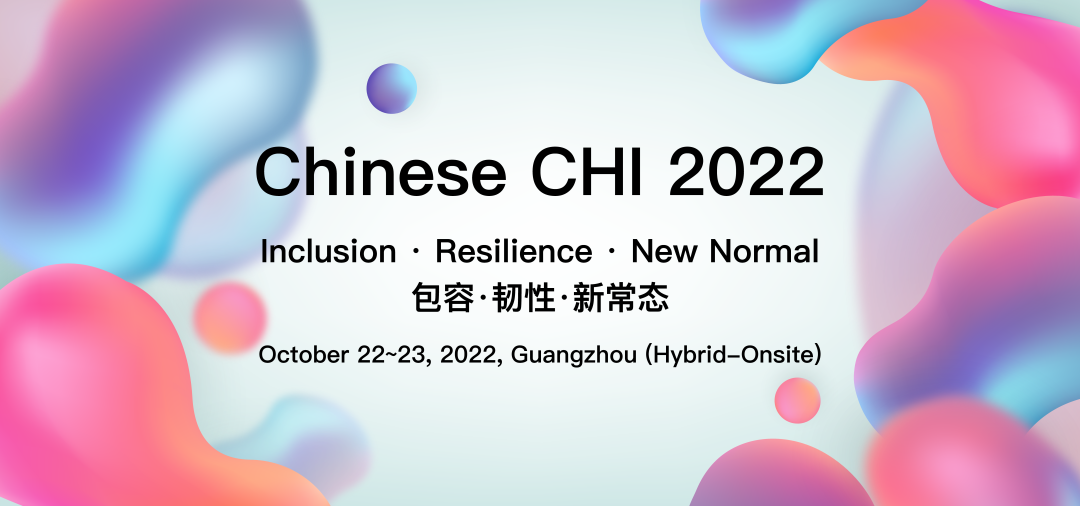
Chinese CHI 2022 focuses on Inclusion, Resilience, and New Normal in the post-pandemic era. The conference will take place online on November 5–6, 2022, hosted by the School of Art and Design, Guangdong University of Technology, Guangzhou, China.
Organized by International Chinese Association of Computer Human Interaction (ICACHI), this conference has become an important connection among Chinese HCI scholars, academia, and industry worldwide. Since 2012, nine editions have been held in Paris, Toronto, Seoul, Silicon Valley, Guangzhou, Montreal, Xiamen, and online. Conference papers are included in the ACM Digital Library and submitted for EI indexing.
The conference offers several workshops for design practitioners and people interested in emerging design areas. They focus on human–computer interaction, industrial design, user experience, user interface design, and related fields, particularly challenging new areas aligned with this year's theme. Topics include fundamental and applied research, HCI practice and education, new methods, emerging applications, and innovative design. Design workshops remain hybrid and will be held November 4, 2022, principally at the Dongfeng Road campus of Guangdong University of Technology, Yuexiu District, Guangzhou.
We warmly invite corporate research, design, and engineering teams to organize workshops. Workshops provide discussion platforms and opportunities to collect data and feedback for emerging design areas and new technology tests.
We also warmly invite doctoral students in HCI and design to organize workshops as platforms for sharing findings or evaluating design methods. This is an excellent opportunity to identify common research interests and share resources.
Workshop Program
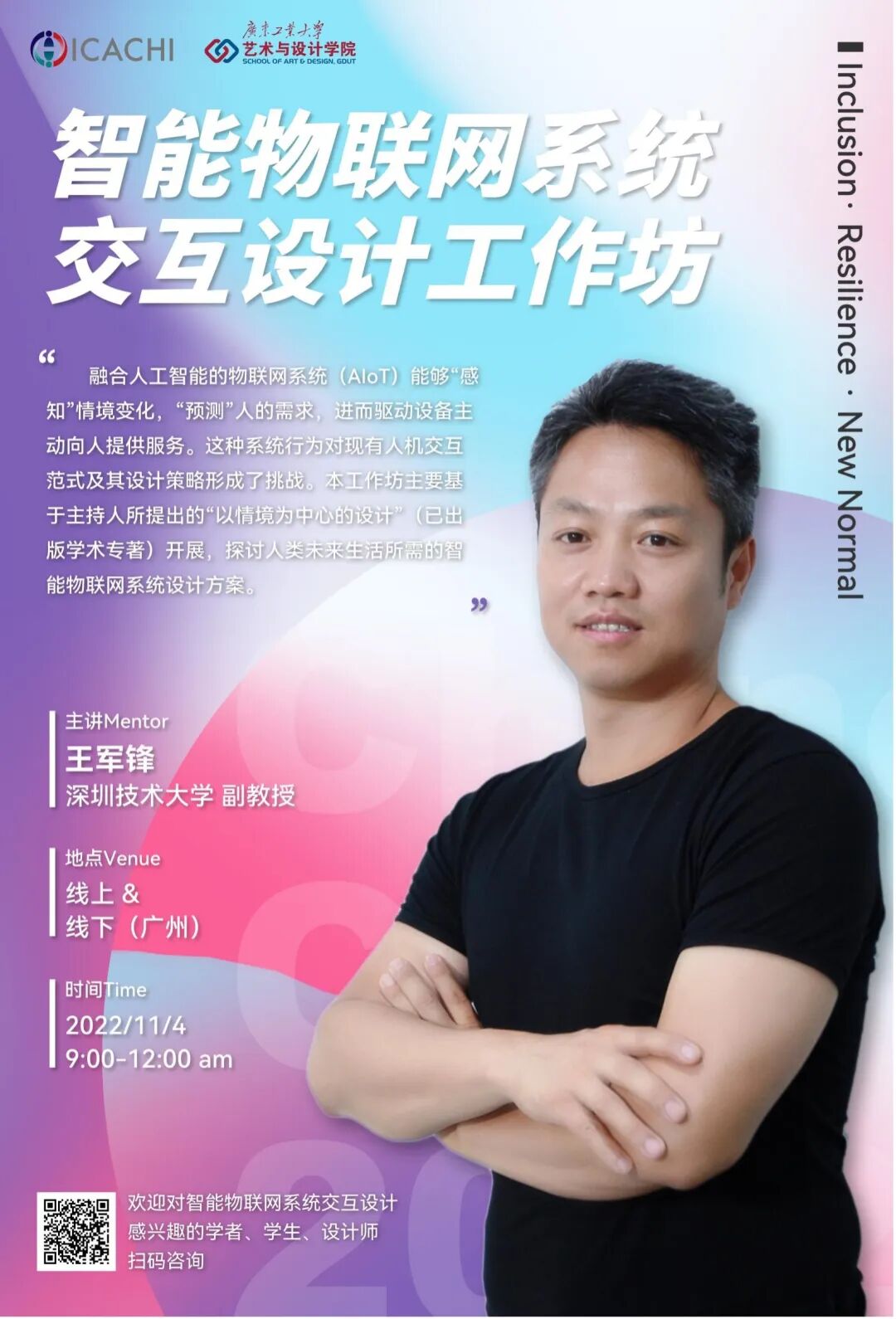
Interaction with Intelligent IoT Systems
Workshop 1
- Fee: RMB 800 per person online; RMB 1,000 in person
- Capacity: 20
- Time: November 4, 2022, 09:00–12:00
- Venue: Ideological and Political Education Classroom, fifth floor of the library
- Format: online and in person
- Description: A research presentation introduces theories and methods of interaction design for intelligent IoT systems, including design challenges arising from evolving artificial systems and design activity, AIoT human–system interaction models, and context-centered design. It explains concept generation and assessment through context–service matching, and tools such as narrative, diagrammatic, and formal representation models. Groups use these tools to present, assess, and select design concepts.
- Organizer: Junfeng Wang, Shenzhen Technology University
- Moderator: Qian Wan, assistant professor, School of Art and Design, Guangdong University of Technology
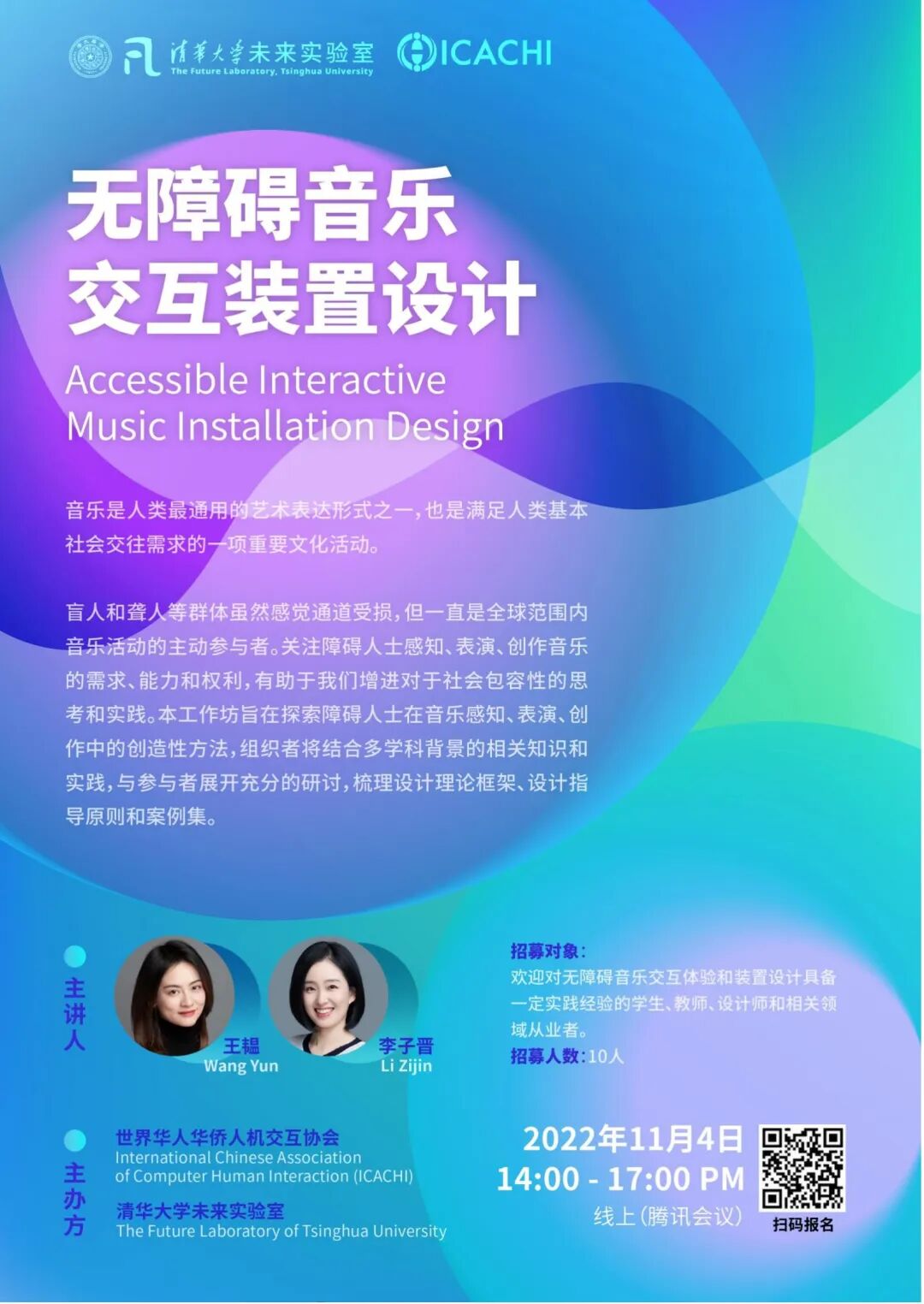
Accessible Interactive Music Devices
Workshop 2
- Fee: Free
- Capacity: 10
- Time: November 4, 2022, 14:00–17:00
- Venue: Room 5-609 / Tencent Meeting
- Format: online and in person
- Description: Case studies explore creative approaches to music perception, performance, and creation by people with disabilities. Attending to their needs, capabilities, and rights to perceive, perform, and create music helps designers advance social inclusion in thought and practice.
- Organizers: Yun Wang and colleagues, Future Laboratory at Tsinghua University, and International Chinese Association of Computer Human Interaction
- Moderator: Li Pan, assistant professor, School of Art and Design, Guangdong University of Technology
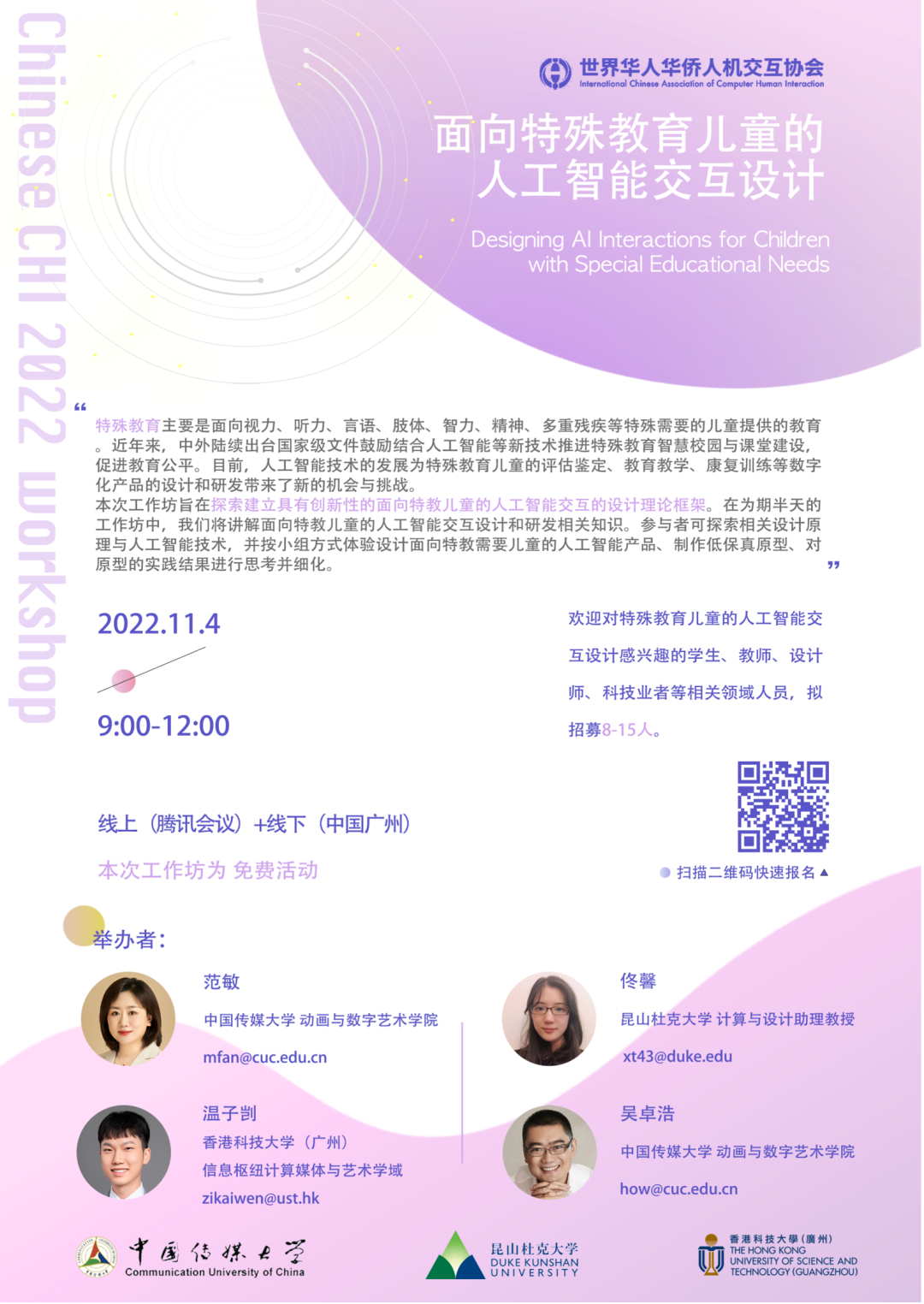
AI Interaction Design for Children with Special Educational Needs
Workshop 3
- Fee: Free
- Capacity: 15
- Time: November 4, 2022, 09:00–12:00
- Venue: Library Meeting Room 203-1 / Tencent Meeting
- Format: online and in person
- Description: Introduces interdisciplinary knowledge of AI capabilities, design methods and tools, and the personal and learning characteristics of children with special needs, proposing an initial design framework. Participants work in groups on three research and design activities: discussing and extending the framework; applying it to a specific case and making a low-fidelity prototype, such as a paper prototype; and reflecting on practice to refine the framework. The workshop aims to reveal further opportunities.
- Organizers: Min Fan and colleagues, School of Animation and Digital Arts, Communication University of China, and others
- Moderator: Tiansheng Xia, associate professor, School of Art and Design, Guangdong University of Technology
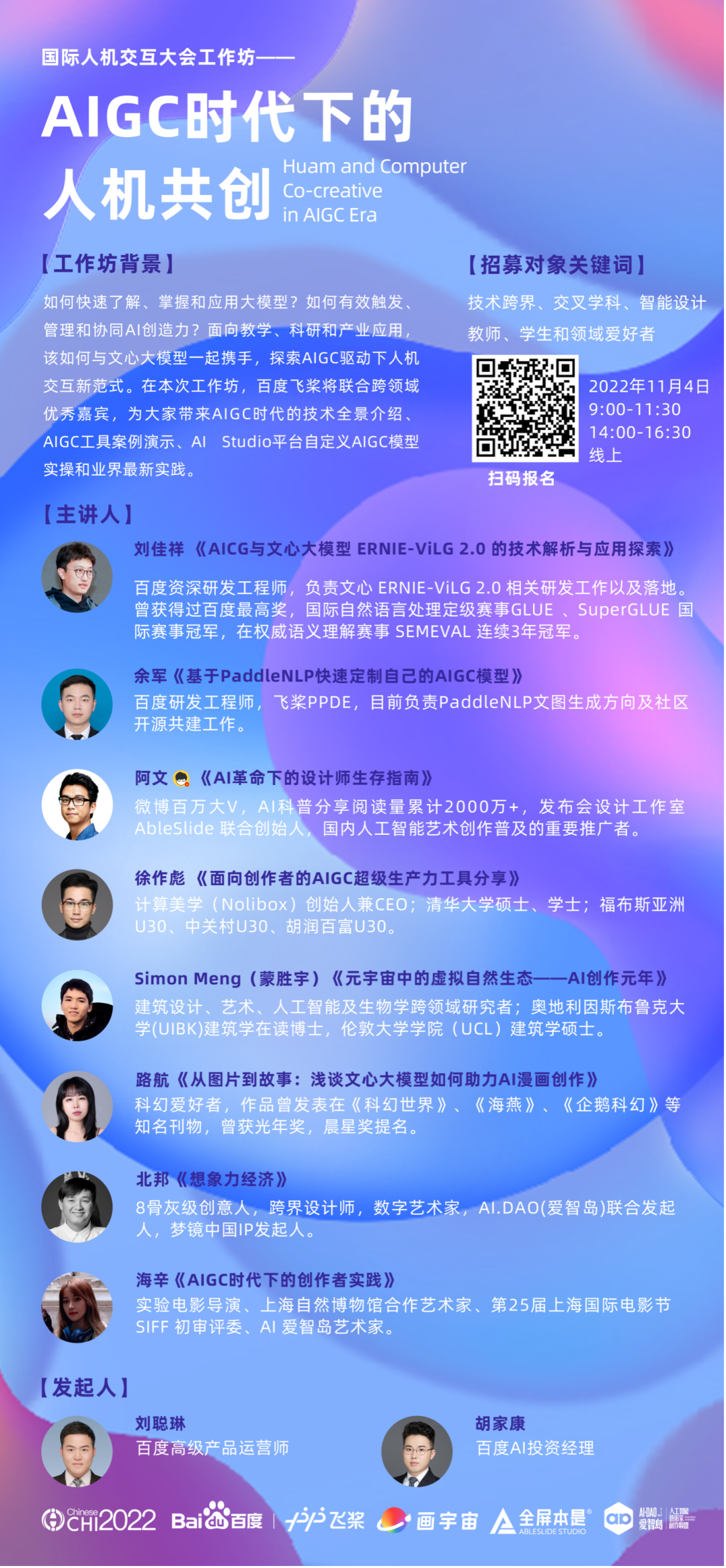
Human–AI Co-Creation in the AIGC Era: From Theory to Practice
Mastering Large Cross-Modal AI Image Generation Models
Workshop 4
- Fee: Free
- Capacity: 25
- Time: November 4, 2022, 10:00–12:00 and 14:00–17:00
- Venue: Room 7-808
- Format: online and in person
- Description: In Human–AI Co-Creation in the AIGC Era, senior Baidu R&D engineers present an overview of AIGC technologies, demonstrate tools and cases, and provide hands-on coding on the AI Studio platform. Combining theory and practice, they explain the field from algorithm development and engineering perspectives, moving from introductory to advanced and broad to specialized topics, offering a reference for design researchers and practitioners, interdisciplinary researchers, and enthusiasts.
- Organizer: Conglin Liu, senior product operations specialist at Baidu
- Moderator: Yong Zhang, assistant professor, School of Art and Design, Guangdong University of Technology
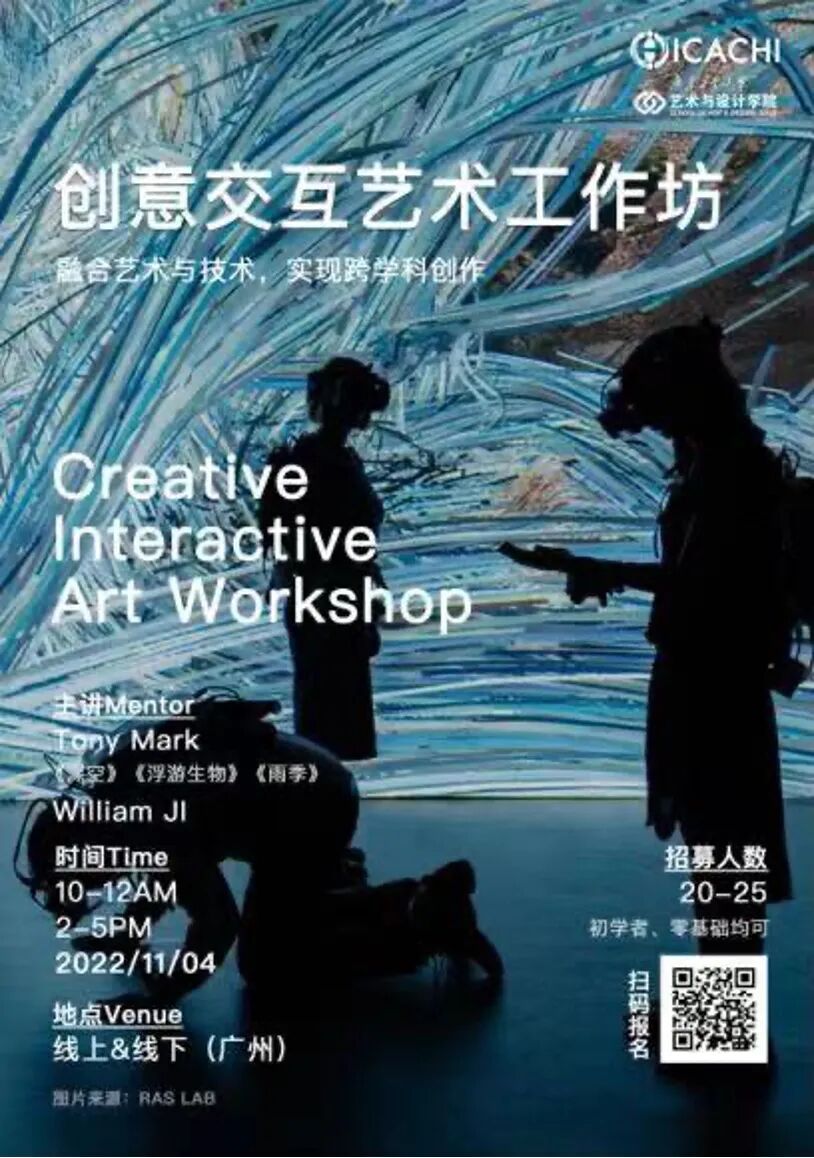
Creative Interactive Art
Workshop 5
- Fee: RMB 600 per person online; RMB 800 in person
- Capacity: 25
- Time: November 4, 2022, 10:00–12:00 and 14:00–17:00
- Venue: Room 5-401
- Format: online and in person
- Description: Participants learn to use relevant software creatively and understand the logic behind the creative process. Combining theory and practice, they select their own topics and conclude with a public presentation.
- Organizers: Tony Mark and William Ji, Qianhe Culture
- Moderator: Minghui Tian, assistant professor, School of Art and Design, Guangdong University of Technology

Visual design: Keqi Chen, University of Edinburgh
Layout and editing: Yuxin Xu, University of Toronto