
Join Us at Chinese CHI 2022

November 5–6, 2022, School of Art and Design, Guangdong University of Technology, Guangzhou (hybrid format)
Chinese CHI 2022 focuses on Inclusion, Resilience, and New Normal in the post-pandemic era. It will take place November 5–6, 2022, at the Dongfeng Road campus of the School of Art and Design, Guangdong University of Technology, Guangzhou, China, with online and in-person participation.
Organized by International Chinese Association of Computer Human Interaction (ICACHI), this academic conference has become an important connection among Chinese HCI scholars, academia, and industry worldwide.
Since 2012, nine editions of Chinese CHI have been held in Paris, Toronto, Seoul, Silicon Valley, Guangzhou, Montreal, Xiamen, and online. Conference papers are included in the ACM Digital Library and submitted for EI indexing.
Conference Program
The main conference schedule is as follows:
November 5
Morning: Opening Ceremony and Keynotes
Keynote Speakers:
Professor Don Norman
Distinguished Professor, University of California San Diego; founder and first director of the Design Lab
Professor Pintian Lyu
Director and Distinguished Professor, Folk Art Research Institute, China Academy of Art
Professor Peter Childs
Fellow of the Royal Academy of Engineering; advisory professor at Guangdong University of Technology
Professor Yingqing Xu
Professor, Academy of Arts and Design, Tsinghua University; director of the Future Laboratory
Professor Xiangshi Ren
Member of the Engineering Academy of Japan; advisory professor at Guangdong University of Technology
Afternoon: Oral Presentations of Accepted Papers
Full Paper Presentations: Parallel Sessions I and II
Late-Breaking Work Presentation Session
Panel: Interdisciplinary Integration in human–computer interaction and Models for Industry–Academia–Research Collaboration
Welcome Banquet
November 6
Two thematic sessions will run concurrently, with speakers being finalized. Leading scholars and experts from China and abroad will deliver talks, including Professor Jie Hu, Dr. Jacek Gwizdka, Professor Chirag Shah, Dr. Michelle Rogers, Dr. Fan Yang, Dr. Max Wilson, Professors Fang Liu, Jingyan Qin, Yinwei Zhan, Yongjian Huai, Dingbang Luh, Wen Zhou, Shaoxu Tian, Professor Jun Hu, international artist Sean Clark, and Dr. Dee Bennett Gayle.
Thematic Forum I: Human-Engaged Computing
Thematic Session II: Future Developments in Intelligent Interaction
Closing and Awards Ceremonies
The conference also features an art exhibition, workshops, and a student competition. Please follow further announcements. We warmly invite you to register.
Registration
Renowned scholars and experts from China and abroad will give keynotes. Registration is now open, and we invite participants from all sectors to explore new design methods and possibilities for human–computer interaction in the post-pandemic era.
Registration remains open. See the website for registration information: http://chchi2022.icachi.org/index.html

Host

Sponsor

Supporters
Art Gallery
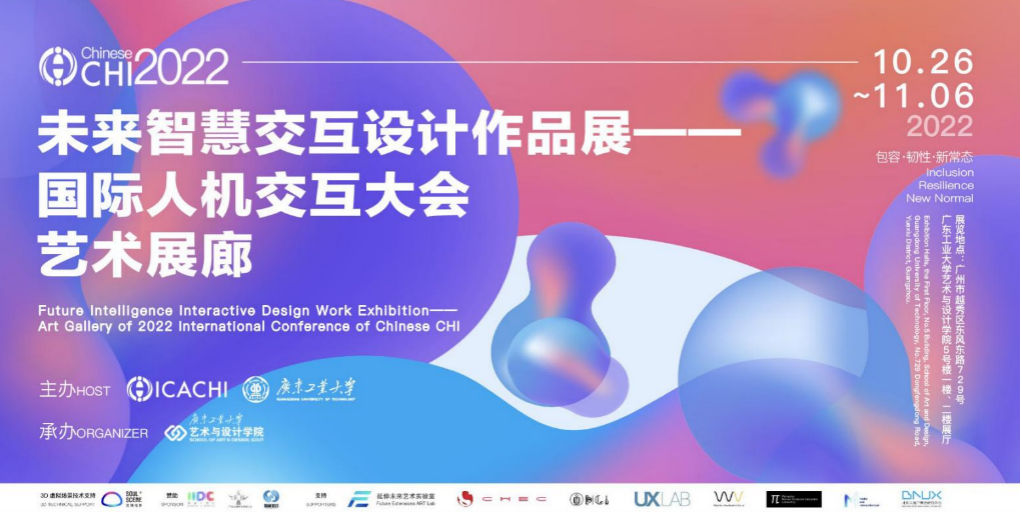
The Art Gallery will open October 26 and continue through November 6. We invite practitioners, researchers, and students in art and design to submit digital artwork proposals to the Chinese CHI 2022 human–computer interaction conference's exhibition, held both on-site and online. The theme is Inclusion, Resilience, and New Normal.
The Chinese CHI 2022 Digital Art Exhibition aims to create a highly inclusive interdisciplinary space for new media art, novel interaction technologies, original conceptual designs, smart product demonstrations, experimental audiovisual works, explorations of materiality, games, and other interactive experiences. Within the thematic framework, it fosters meaningful exchanges among exhibitors that enrich, extend, or reframe relationships between art, design, and technology.
Workshops
Workshops focus on human–computer interaction, industrial design, user experience, user interface design, and related fields, particularly challenging emerging design areas aligned with this year's theme. Topics include fundamental and applied research, HCI practice and education, new methods, emerging applications, and innovative design.
We warmly invite corporate research, design, and engineering teams to organize workshops at the conference. Workshops provide a discussion platform and convenient opportunities to collect feedback and data for emerging design areas and new technologies.
We also invite doctoral students in HCI and design to organize workshops as platforms for sharing research or evaluating design methods. This is an excellent opportunity to find common research interests and share resources.
Quick Facts:
Six workshops
Interaction Design for Intelligent IoT Systems Workshop
Accessible Interactive Music Devices
AI Interaction Design for Children with Special Educational Needs
Autonomous Driving AI Design
Emotional Sustainability in human–computer interaction: Inclusive Design and Practice
Creative Interactive Art
Date: November 4, 2022; each workshop lasts half a day or a full day
Each workshop will have 8–15 participants.
In accordance with ongoing pandemic prevention measures, workshops will take place both online and in person.
The selected workshops are introduced below:
ChineseCHI Workshop 1:
Interaction Design for Intelligent IoT Systems Workshop
Organizer: Junfeng Wang
The workshop opens with a research presentation on theories and methods of interaction design for intelligent IoT systems. It covers AIoT interaction design problems arising from the evolution of artificial systems and design activity, AIoT human–system interaction models, and context-centered design theory and methods. Real project examples illustrate how to generate and evaluate design concepts through context–service matching, as well as design tools including narrative, diagrammatic, and formal representations of AIoT interaction design.
Participants form groups and choose design topics, then generate ideas through several rounds of brainstorming with members moving between groups. Each group presents its concepts using the tools learned. All concepts are evaluated using the assessment tools, and the strongest are selected.
ChineseCHI Workshop 2:
Accessible Interactive Music Device Design Workshop
Organizer: Yun Wang
Music is among humanity's most universal forms of artistic expression and an important cultural activity meeting basic social needs. Although their sensory channels may be impaired, blind and deaf people actively participate in music worldwide. Attending to disabled people's needs, capabilities, and rights to perceive, perform, and create music can deepen inclusive social thinking and practice.
This workshop brings together scholars and artists from diverse disciplines to share cases and discuss creative approaches to music perception, performance, and creation by people with disabilities.
ChineseCHI Workshop 3:
AI Interaction Design for Children with Special Educational Needs Workshop
Organizer: Min Fan
Advances in AI create opportunities and challenges for learning interfaces for children with special needs. This workshop introduces innovative methods and processes for designing AI interfaces in special education, embracing broader uses of AI at different design and evaluation stages. Participants and organizers will explore principles and gain hands-on experience creating AI interfaces for children with special educational needs.
In this half-day workshop, organizers first introduce interdisciplinary knowledge of AI capabilities, design methods and tools, and the personal and learning characteristics of children with special needs, together with an initial design framework. Participants work in groups on three activities: (1) discussing and extending the framework; (2) applying it to a specific design case and producing a low-fidelity prototype, such as a paper prototype; and (3) reflecting on the practice and refining the framework. Researchers and practitioners may discover further opportunities through the workshop.
ChineseCHI Workshop 4:
Autonomous Driving AI Design Workshop
Organizer: Conglin Liu
Participants design physical or graphic road elements for a specific space and use Baidu's PaddlePaddle AI pipeline to build an autonomous model car for a miniature road environment. This combines transportation environment design, urban design, architecture, and other disciplines while building confidence and skills in working with AI. Baidu's model car, for example, is an official platform for the National University Students' Intelligent Car Competition. Its appearance, map, driving tasks, and dynamic projections on the car body all offer opportunities for human–computer interaction design.
ChineseCHI Workshop 5:
Emotional Sustainability in human–computer interaction: Inclusive Design and Practice Workshop
Organizer: Lu Zhao
Inclusive design, widely researched and applied in product design, architecture, and other fields, is a method and process that embraces and realizes human diversity. Digital technologies have reshaped human thought and design paradigms, but creating equitable, open, integrated, friendly, and sustainable human–computer interaction environments remains our responsibility and goal.
Focusing on diversity among users of interactive products, this workshop teaches inclusive design concepts and methods. Students consider how products, services, environments, and experiences can lower barriers to social participation, developing inclusive interactive prototypes or solutions that meet the needs of as many people as possible, including people with physical or mental disabilities and people of different racial backgrounds and genders.
ChineseCHI Workshop 6:
Creative Interactive Art Workshop
Organizers: TonyMark and Yi Ji
Software used in this workshop:
VVVV enables new media art creation without writing code, helping creators without programming experience combine art and technology across disciplines. Each effects module can be controlled separately, like an individual Photoshop layer, and modules can be connected to combine effects, like layering images. Instead of writing code, users simply drag and drop to realize imaginative ideas.
The workshop teaches students to use the software for creative work and understand the underlying logic of creation. Combining theory and practice, participants choose their own topics and conclude with a public presentation.
Student Competition
We invite students from diverse backgrounds, including human–computer interaction, industrial, product, visual, user experience, and interaction design, to enter the Student Competition on-site or online.
The Chinese CHI competition showcases students' ideas and skills in human–computer interaction design and user experience, raising their work's visibility and providing expert feedback.
For details, follow the official website:
http://chchi2022.icachi.org/index.html
First draft: Cheng Zhao
Editors: Bin Luo and Yuqiao Liu
Review: Li Zhang
Final review: Shizhu Lu