
Important: Chinese CHI 2022 Rescheduled to November 5–6, 2022
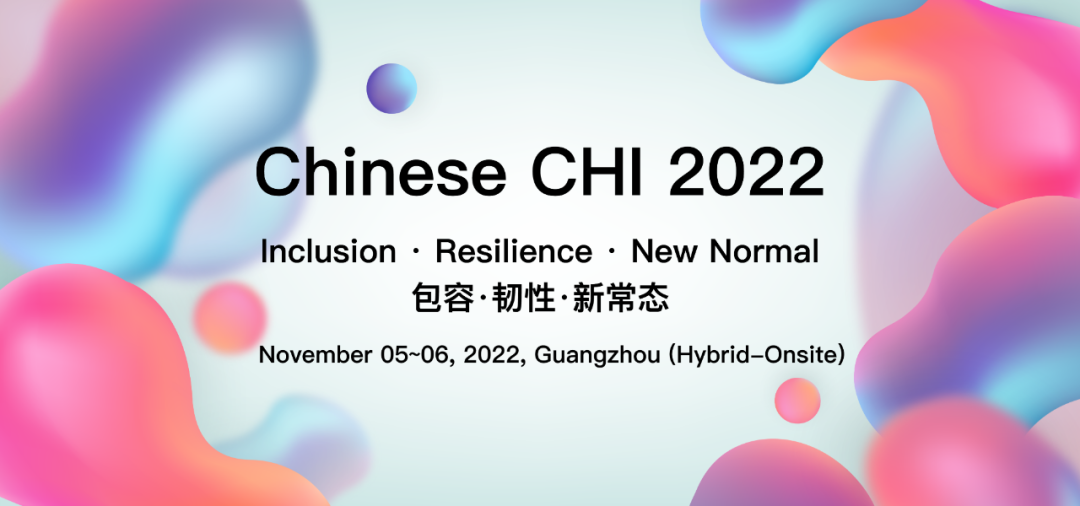
Inclusion . Resilience . New Normal
Chinese CHI 2022, organized by International Chinese Association of Computer Human Interaction (ICACHI), has been rescheduled to November 5–6, 2022, in Guangzhou, China, in a hybrid format. The theme is Inclusion, Resilience, and New Normal.
Organized by International Chinese Association of Computer Human Interaction (ICACHI), this academic conference has become an important meeting point for Chinese HCI scholars, academia, and industry worldwide. Since 2012, Chinese CHI has been successfully held in Paris, Toronto, Seoul, Silicon Valley, Guangzhou, Montreal, and Xiamen. Papers from previous conferences are included in the ACM Digital Library and submitted for EI indexing.
As the global pandemic continues, humanity again stands at a historical crossroads, while economic globalization shows renewed resilience. In response to this evolving global challenge, this conference seeks to explore the value, significance, and social contribution of human–computer interaction in the post-pandemic era.
Event Highlights
Academic Conference
- The conference is supported by academic and industry partners and features keynote speakers and workshop guests from internationally renowned universities and companies.
- Authors will present accepted papers as talks or video introductions during the conference. Participants will have opportunities to exchange ideas with human–computer interaction scholars worldwide.
- At least one author of each accepted, peer-reviewed paper must pay the conference registration fee.
- For registration details, visit the conference website:
- chchi2022.icachi.org
Interaction Design Workshops
Interaction Design Workshop
- The conference invites corporate design and development teams, advanced doctoral students, and university research groups to use the Chinese CHI 2022 human–computer interaction conference workshops to share recent human–computer interaction technologies and research methods, exchange experience and findings, and inform future research.
- Chinese CHI 2022 particularly encourages two types of workshop proposal:
- - Interaction Platform Workshops: Companies or individuals provide development platforms, open-source tools, or design tools, such as Google's tensorflow.js, Huawei's Data Lake Visualization platform, or the CARLA open-source driving simulator. Participants develop creative ideas and rapidly build interactive prototypes or design proposals for discussion. The outcomes can inform organizers' research.
- - Co-Design Workshops: Companies or individuals propose discussion topics based on their research methods or projects, such as data-driven design, data visualization, explainable AI, human–AI collaboration, or smart glasses. Participants brainstorm, develop creative ideas, and produce rapid sketches and proposals for cross-discussion. Outcomes can help companies or individuals evaluate their research methods.
- Chinese CHI 2022 workshops may last half a day or a full day and are expected to take place on November 4, the day before the conference, in a hybrid format. Each workshop is expected to have 8–15 participants**.**
Digital Art Exhibition
Digital Arts Gallery
- The conference invites practitioners, researchers, and students in art and design to submit digital artwork proposals to the Chinese CHI 2022 human–computer interaction conference's Digital Art Exhibition, which will take place on-site and online.
- The Chinese CHI 2022 Digital Art Exhibition aims to create a highly inclusive interdisciplinary space for new media art, novel interaction technologies, original conceptual designs, smart product demonstrations, experimental audiovisual works, explorations of materiality, games, and other interactive experiences. Within its thematic framework, the exhibition fosters meaningful exchanges among exhibitors to enrich, extend, or reframe relationships between art, design, and technology.
- A committee of experienced specialists in relevant fields, to be announced later, will review all submissions. Selected works will be archived in the Chinese CHI 2022 Digital Art Exhibition yearbook, and authors will receive an ICACHI exhibition award certificate.
Student Competition
- The conference invites students from diverse design backgrounds, including human–computer interaction, industrial, product, visual, user experience, and interaction design, to enter the Student Competition on-site or online.
- The competition showcases students' ideas and skills in human–computer interaction design and user experience, raising the visibility of their work and providing expert feedback.
- Submissions will be assessed by a committee of experienced experts in relevant fields, to be announced later, and through an online audience vote. Final award recipients will be invited to exhibit their award-winning work at the Digital Art Exhibition and receive an ICACHI competition award certificate.
Chinese CHI 2022 website:
http://chchi2022.icachi.org/index.html

Visual design: Keqi Chen, University of Edinburgh
Layout and editing: Yuxin Xu, University of Toronto